 Tech


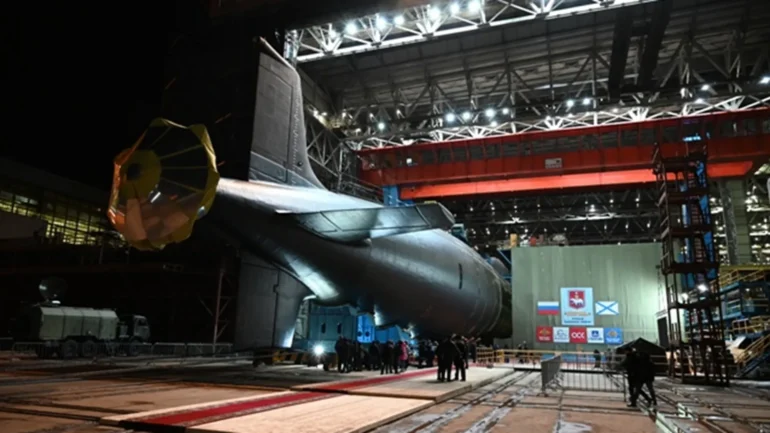
Perm nuclear submarine: Russia has formally commissioned its Perm nuclear-powered submarine, which Moscow says is the first multipurpose submarine to carry Zircon hypersonic cruise missiles as standard armament. The vessel was transferred to the Russian Navy on Friday, November 27.. More in our defense section.
President Vladimir Putin attended the flag-raising ceremony at the Sevmash shipyard in Severodvinsk. He described Russia as one of the few countries able to build powerful nuclear submarines and weapons “with global reach and significance,” according to Al Jazeera, citing Kremlin footage.
Perm nuclear submarine: What Perm is
Perm is a fourth-generation, multipurpose nuclear-powered attack submarine of Russia’s Project 885M Yasen-M class. Sevmash built it. It is the sixth submarine in the wider Yasen series and the fifth of the modernised Yasen-M variant.
The boat was launched on March 27, 2025, in a ceremony Putin attended remotely. Russian officials said then that Perm would be the first Yasen-M submarine designed to carry Zircon hypersonic cruise missiles as part of its standard loadout, and that it would enter service in 2026. Friday’s ceremony met that timeline.
According to Sevmash, Yasen-M submarines carry modern navigation, communications and hydroacoustic systems, along with precision weapons and robotic systems.
Zircon and long-range strike
The Zircon missile is built for high-speed strikes on naval and land targets. Putting it on the Yasen-M class is meant to strengthen Russia’s ability to hit targets at long range from underwater platforms.
Nuclear propulsion also lets the submarine carry out extended missions without the frequent refuelling that conventionally powered vessels need.
Multipurpose attack submarines like Perm differ from ballistic missile submarines, which form a core part of Russia’s nuclear deterrent. Attack boats are designed for a wider set of missions, including anti-ship warfare and precision strikes.
More submarines planned
At the ceremony, Putin said Russia plans to deliver five more nuclear-powered submarines to its navy by 2030. Three of them will be Yasen-M-class boats, which Russia intends to deploy across different maritime regions carrying a range of cruise missiles.
Putin also repeated Moscow’s commitment to modernising its naval forces, including submarines, surface ships, weapons and onboard communications. He said Russia would keep raising the pace and scale of naval construction while fitting new vessels with advanced systems.
At the 2025 launch, Putin said the Yasen-M programme would strengthen Russia’s naval position in several maritime regions, including the Arctic. He also stressed the importance of protecting the Northern Sea Route, which Moscow regards as strategically significant for trade, transport and national security.
Source: Interesting Engineering
Perm nuclear submarine: Strategic Implications
The commissioning of the Perm nuclear submarine represents a significant moment in Russia’s naval modernisation programme. Armed with Zircon hypersonic missiles that can travel at speeds exceeding Mach 8, the vessel adds a new dimension to Russia’s nuclear deterrence capability. The Zircon missile is designed to evade existing missile defence systems through its combination of extreme speed and low-altitude flight path, making it a formidable threat to naval surface groups and coastal defence installations.
For NATO planners, the Perm nuclear submarine and its hypersonic armament raise important questions about the adequacy of current anti-missile systems. Western navies have invested heavily in ballistic missile defence, but hypersonic weapons pose different challenges due to their unpredictable flight trajectories and the compressed timeline available for detection and response. The deployment of such weapons on a submarine platform, which can operate undetected for extended periods, further complicates defensive planning.
The Perm nuclear submarine is part of Russia’s broader effort to maintain strategic parity with the United States and China in advanced weapons systems. While economic sanctions have slowed some Russian defence programmes, submarine construction has remained a priority, with several additional vessels of this class reportedly under construction at the Sevmash shipyard.