 Tech



IP address blocking poses growing risks: to take down a pirate site is increasingly likely to knock out unrelated websites too, according — a trend our internet coverage has followed — to new research from Stanford University and Cloudflare. The researchers found that sharing a single address across many domains is now the norm rather than the exception.
The paper, “On IP Addresses as Identifiers of Internet Users and Services,” was presented at an Internet policy research conference in Washington DC in September. It asks whether IP addresses are a reliable way to identify websites and the people behind them. The authors’ answer is no.
IP address blocking: A Decade of DNS Data
The team analysed ten years of DNS records for .com, .net and .org domains and ran its own DNS queries for the web’s most popular domains. As of February 2025, only 0.2% of those domains had an IP address to themselves. Even among the top million most popular domains, just 9% used an address exclusively.
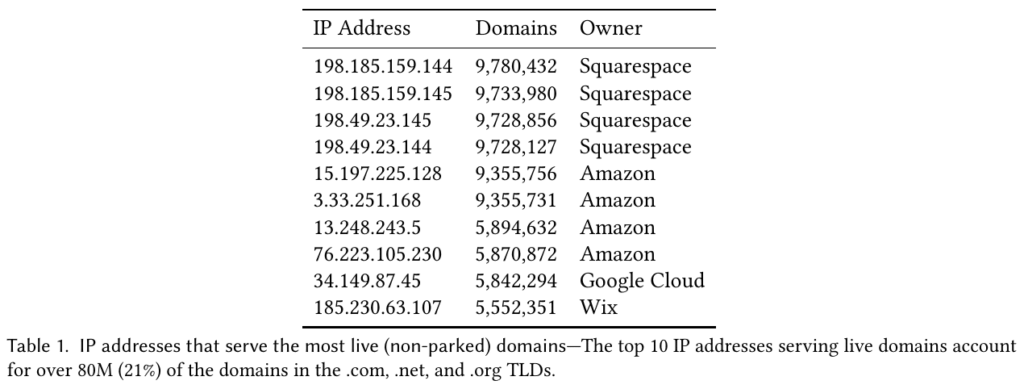
At the other extreme, the ten IP addresses hosting the most live domains, run by Squarespace, Amazon, Google Cloud and Wix, serve more than 80 million domains between them. Amazon, Cloudflare and Google Cloud routinely host thousands of domains behind one address, the researchers said, and that count excludes subdomains.
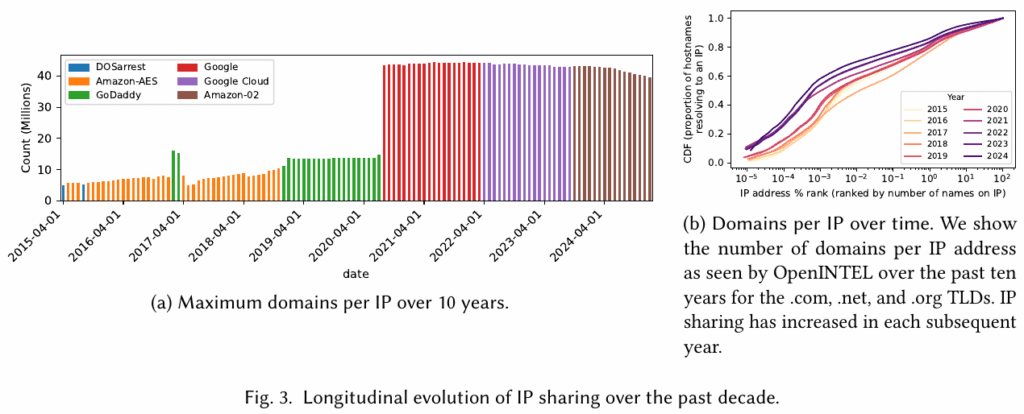
The trend is also growing. In 2015, 0.9% of IP addresses in the dataset accounted for 80% of domains. By 2024, the same share of domains sat on just 0.2% of addresses.
Why an IP address is not an identity
A single server can host many sites on one address. When a browser connects, it tells the server which site it wants through a field called Server Name Indication (SNI). The IP address alone therefore says little about what sits behind it.
The authors compare IP addresses to street addresses. “Looking at a street address does not reveal the number of suites, business, or people who use it,” they write. They argue that blocking at the IP level can often take down far more than intended.
Austria and Spain as examples
The researchers point to a 2022 order requiring Austrian internet providers to block pirate domains and several Cloudflare IP addresses. Because those addresses were shared, thousands of unrelated sites became unreachable.
In Spain, a court order obtained by football league LaLiga requires ISPs to block IP addresses used by pirate streams. The researchers say the blocks applied during matches have regularly included Cloudflare addresses, and that they recently made Movistar’s own support forum unreachable.
Research from the Open Observatory of Network Interference, cited in the paper, found more than 550,000 of 9.2 million tested domains were blocked at some point during LaLiga broadcasts between January and June. Cloudflare partly sponsored that work. LaLiga has questioned its methodology and previously said its blocking is “focused, precise, and without collateral impact on legitimate services.”
Cloudflare has a stake in the topic: one of the four authors works there, another is a former employee, and part of the data comes from Cloudflare’s traffic logs.
Domain blocking is no clean fix
The paper says overblocking has pushed some regulators toward blocking by domain name instead. That has limits too, because Encrypted Client Hello (ECH) hides the site name from internet providers. LaLiga’s own court case cited ECH as an obstacle. Whether ECH will keep IP-level blocking in use remains open, the researchers said.
The study lands as two competing bills in the US Congress would let rightsholders seek court orders requiring providers to block foreign pirate sites. Neither rules out IP blocking. The DEFEND IP Act leaves technical measures to providers, though judges must weigh whether blocking would interfere with access to non-infringing material. Rep. Issa’s American Copyright Protection Act offers up to $250,000 to affected operators if the rightsholder caused the error.
The researchers conclude that the community needs to debate how to balance privacy and legal takedown mandates “while at the same time preventing collateral damage.”
Source: TorrentFreak