 Tech



fiber optic earthquake sensor technology: Scientists have used a spare strand of broadband fiber in New Zealand to image a dangerous earthquake fault in far finer detail than conventional seismic networks allow. The team, led by NTU Singapore, turned a 30 km (18.6-mile) stretch of cable along the Haast Pass highway into thousands of virtual sensors spaced just 4 meters (13 feet) apart.. Read more in our technology section.
The target was the Alpine Fault on South Island, where the Australian and Pacific plates meet. It last produced a major earthquake in 1717. A 2021 study put the odds of a magnitude 7 or larger rupture within the next 50 years at around 75%.
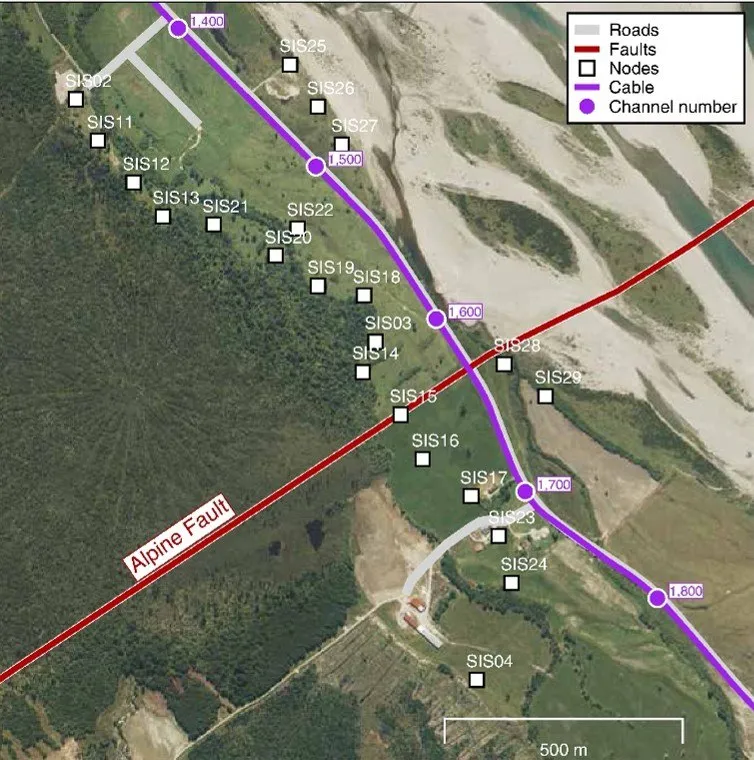
fiber optic earthquake sensor: How a data cable becomes a seismometer
Working with telecom company Chorus, the researchers sent laser pulses down an unused, or “dark,” fiber. The technique is called distributed acoustic sensing (DAS). Seismic waves stretch and squeeze the glass by tiny amounts, and changes in the reflected light reveal what is happening underground.
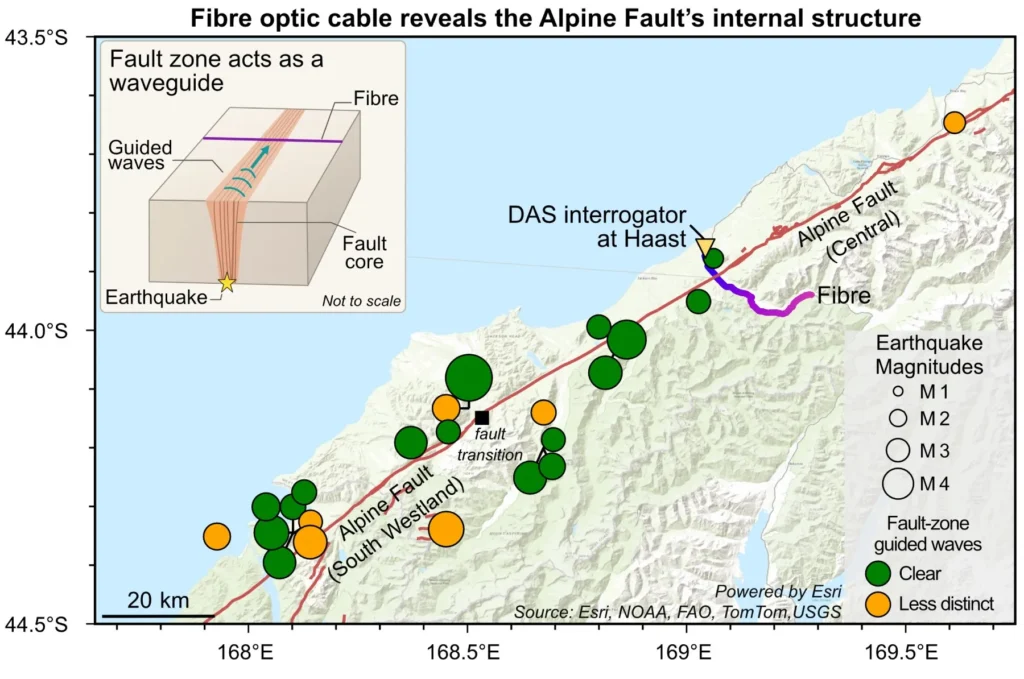
Over 140 days in 2023, the cable recorded 67 local earthquakes. Sixteen of them produced fault-zone guided waves, which are bursts of energy trapped inside fractured rock.
Simulations based on those waves indicated that the fault is a band of shattered rock roughly 200 meters wide. It contains up to six narrow slip cores, each about 10 meters across.
Resolving what other tools miss
In their paper in Science Advances, the researchers said the approach, combined with passive seismic imaging, can resolve individual fault cores within the zone where earthquakes originate on a mature plate-boundary fault. They said it overcomes scale limits of conventional seismic imaging and shallow field observations.
In practical terms, the cable can pick out problem areas about 10 meters wide at the depths where quakes begin. Regular seismometer networks cannot do that.
What it means for hazard planning
The main core runs unbroken for about 180 km (112 miles). That includes a bend near the Martyr River, which has halted some prehistoric earthquakes and let others rupture straight through.
The findings suggest the two fault segments remain linked at depth. Models in the study give an 82% chance that a joint rupture would exceed magnitude 8. The result does not change when the next earthquake is expected, but it gives hazard planners firmer data to work with.
Live cables can do it too
The NTU team used a dark fiber, but cables carrying live traffic can serve the same purpose. Researchers working with Google turned the company’s Curie subsea cable into an earthquake sensor by reading the polarization of ordinary internet traffic. That method needed no dedicated fiber or special lasers.
That matters because seafloor instruments are difficult and expensive to deploy and maintain. Fiber is cheap by comparison. Stanford’s Biondo Biondi has said each meter of fiber works as a sensor that costs less than a dollar to install.
Source: Digital Trends
How fiber optic earthquake sensor Networks Could Transform Disaster Preparedness
The concept of using spare internet fiber as a fiber optic earthquake sensor represents a paradigm shift in seismology. Traditional earthquake monitoring relies on purpose-built seismometers that are expensive to deploy and maintain, limiting coverage to key geological areas. By contrast, fiber optic cables are already laid across vast distances, including under oceans and through remote regions, offering potential sensor coverage that would be impossible to achieve with conventional equipment.
For earthquake-prone regions like New Zealand, Japan and the west coast of the United States, fiber optic earthquake sensor technology could provide crucial early warning seconds before destructive waves arrive. These additional seconds can be enough for automated systems to slow trains, shut gas valves and alert emergency services. The technology works by detecting tiny changes in light signals travelling through the fiber caused by ground vibrations, effectively turning thousands of kilometres of existing cable into one continuous seismometer.
Telecommunications companies and research institutions are now exploring commercial partnerships to deploy fiber optic earthquake sensor systems at scale. The low additional cost of monitoring spare fiber capacity makes this approach particularly attractive for developing nations that lack extensive seismometer networks but have growing fiber optic infrastructure for internet connectivity.