
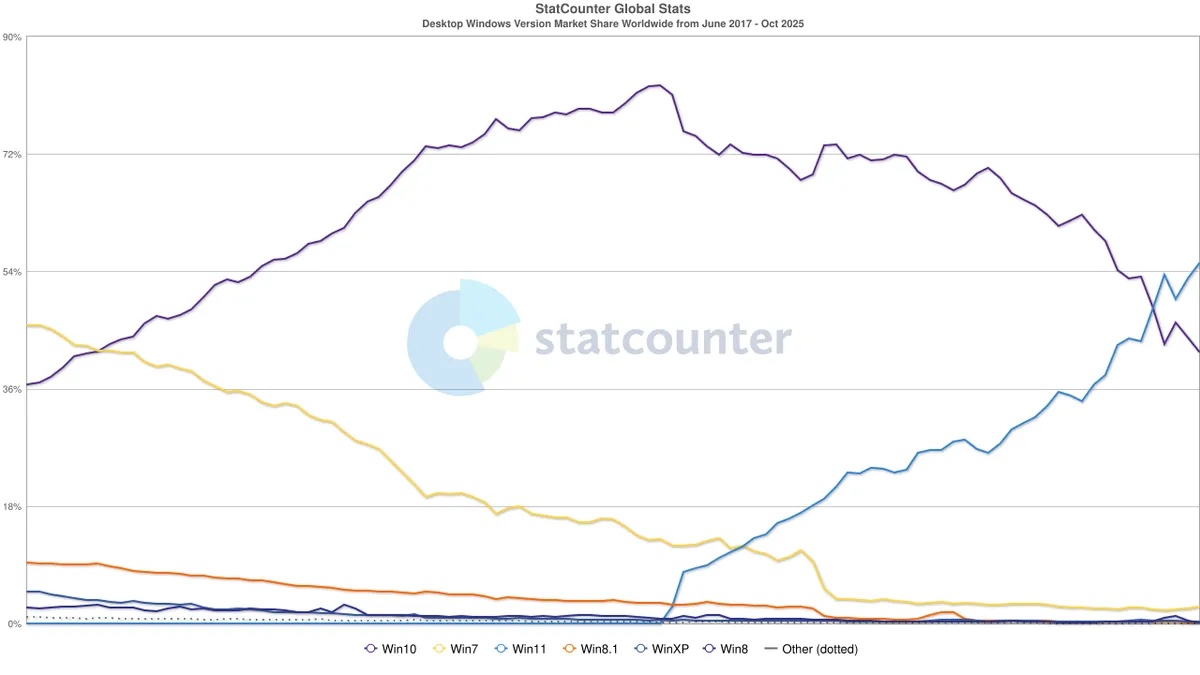
Almost one month has passed since Microsoft officially ended support for Windows 10, yet the global user base shows little sign of moving away from the retired OS. Statcounter data for October 2025 places Windows 10 on 41.7 percent of all Windows machines. Windows 11 leads at 55.2 percent, but the margin is far narrower than expected for an operating system that no longer receives security patches.
A longer view of the past five years reveals steady adoption of Windows 11, but Windows 10 held the top position until July 2025. Even at the moment it lost official support, its usage remained remarkably strong.
Table of Contents
Historical comparison shows slower abandonment than Windows 7
Looking back at Windows 7’s retirement offers useful context. In its final month of support, Windows 7 still held 24.9 percent market share. The transition away from it took roughly three years before it reached negligible levels. The pattern suggests that Windows 10 could take even longer to decline, given its significantly higher share at the time support ended.
Windows 10 has been unusual in its longevity and adoption curve. It rose quickly after launch, reached dominance by late 2017, and overtook Windows 7 well before the latter was discontinued. Its long-term stability, familiar interface, and strong enterprise presence helped preserve that lead.
Why Windows 10 persists despite the risks
Hardware requirements have played an important role in the slow migration. Windows 11 launched with strict compatibility rules that excluded many older systems still in active use. Enterprises facing large hardware refresh cycles postponed upgrades, leaving a substantial number of machines stuck on Windows 10.
Omdia Research Director Ishan Dutt noted before end of support that a significant portion of the global Windows base is either still on Windows 10 or using hardware more than five years old. This is reflected in channel partner surveys, where nearly one fifth reported plans to continue using Windows 10 even after support ended.
Security exposure will increase over time
Running Windows 10 today means operating without new security patches. Any new vulnerabilities will remain unaddressed, making unprotected systems attractive targets for attackers. Hospitals, financial institutions, and public sector agencies face heightened exposure, since prolonged reliance on unsupported operating systems creates weak points across large networks.
Despite these risks, Microsoft has not offered new comments on the gap between Windows 11 adoption goals and the reality of customers holding on to Windows 10.
The transition away from Windows 10 will likely stretch across several years, and the global Windows ecosystem may need a longer adjustment period than any previous support cycle.