 Tech


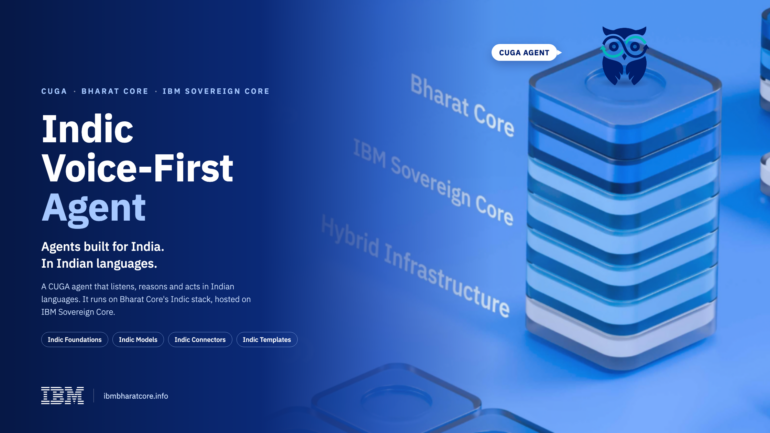
IBM Research has built a voice-based Farm Assistant that listens to questions in Indian languages and answers aloud from an English-language handbook, using its open-source CUGA agent harness. The demo is available to try in CUGA Apps on Hugging Face Spaces, and IBM has published a step-by-step tutorial for building a similar agent.
How the Farm Assistant works
A farmer asks a question aloud in their own language, such as how to tell good seed from bad. The agent turns the speech into text and searches a 154-page agricultural handbook. It then replies in two to four spoken sentences in the language of the question, using only what the handbook says. The app also shows the source pages so users can check the answer.

If someone asks about an unrelated topic such as cricket or coding, the agent steers them back to farming rather than improvising, IBM said.
Text in, text out
CUGA, short for ConfigUrable Generalist Agent, handles model wiring, tool management, state and guardrails. IBM uses it as an embedded SDK inside a small web app. It lets developers switch between watsonx and OpenAI models with one setting, search a parsed and embedded PDF locally, and give each question its own conversation thread so context does not leak between users.
The key design choice is that CUGA only sees text, with speech handled by two thin layers around it. That means the agent can be built and tested in text first, and speech providers can be swapped without touching it. IBM supports Sarvam AI’s cloud speech APIs, called directly from the user’s browser, or open-source models running on the developer’s own server: SraVaani for speech-to-text and Svara for text-to-speech.
The real problem is cross-lingual search
According to IBM, the hardest part was not voice but retrieval. CUGA’s default embedding model is English-only, so a Hindi or Tamil question produces vectors with almost no meaning. The system still retrieves five passages, but they are the wrong ones, and the model, told to answer only from its context, says the handbook does not cover the topic. No error appears.
The fix was a multilingual embedding model, intfloat/multilingual-e5-large, which places the same meaning in the same spot regardless of language. IBM said wiring it into CUGA needed a small workaround, which is covered in the tutorial. Once in place, a single English document can serve every language without translated copies.
IBM’s advice to developers is to ask the agent one question in a non-English language and confirm it finds the right pages before tuning any prompt.
Design choices for speech and safety
- Written for the ear: the prompt tells the model to avoid markdown, bullets, citation tags and bracketed translations, and a light formatter strips any that slip through.
- Cheap guardrails: simple input checks catch obvious off-topic questions. Otherwise the model begins an off-topic reply with OFF_TOPIC and the app swaps in a polite redirect, avoiding a second LLM call.
- Grounded answers: the model sees only the retrieved passages and is told not to use outside knowledge.
- Keys stay client-side: with the Sarvam option, the server receives only text and never sees the user’s key.
Link to IBM Bharat Core
IBM said the approach is not specific to agriculture and could be reused for scheme documents, health advisories or legal guides. It tied the work to IBM Bharat Core, an optimized AI stack built on IBM Sovereign Core to run Indic AI workloads securely on local infrastructure in India.
For enterprise uses such as vernacular KYC or multilingual government bots, IBM said pairing CUGA with Bharat Core’s Indic connectors and fine-tuned models would let developers build compliant, sovereign systems. CUGA is released under the Apache 2.0 licence on GitHub.
Source: Hugging Face Blog