 Tech


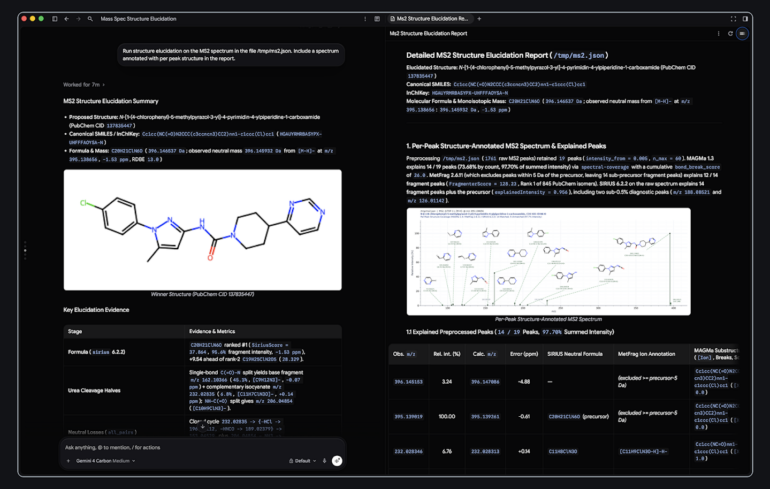
Google DeepMind has released Mass Spec Skills for Google Antigravity, a set of tools that lets a Gemini-powered agent interpret tandem mass spectra and propose the chemical structure behind them. The skills are available today.
The company said the suite pairs Gemini’s chemical reasoning with established, openly available mass spectrometry software and public chemical databases. Researchers describe the task in plain language, and the agent selects and chains the relevant skills, then produces a report that a chemist can review.
The problem: unannotated spectra
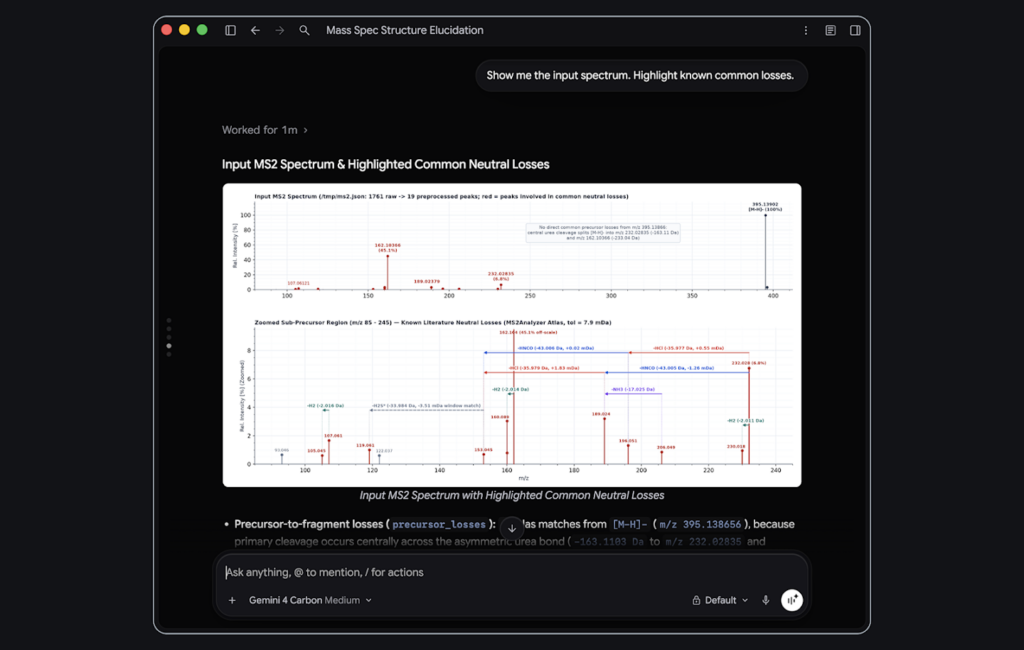
A mass spectrometer can detect tens of thousands of molecular signals in a single drop of sample extract, but the readout does not directly reveal structure. DeepMind said spectral library searches annotate only about 5% of measured spectra on average, and about 10% for human samples. It described the remainder as the “dark matter” of mass spectrometry.
Analytical chemists have a proven workflow: check reference libraries, determine the molecular formula, retrieve candidate structures from databases, and test each against observed fragment peaks. According to DeepMind, doing this by hand for every spectrum is too slow when one study can generate thousands.
How the agent works
In a worked example, the agent took a negative-mode spectrum with 1,761 raw peaks and filtered it to 19. With library lookup disabled, it used the SIRIUS tool to identify the formula C20H21ClN6O. It then scored all 845 matching isomers in PubChem.
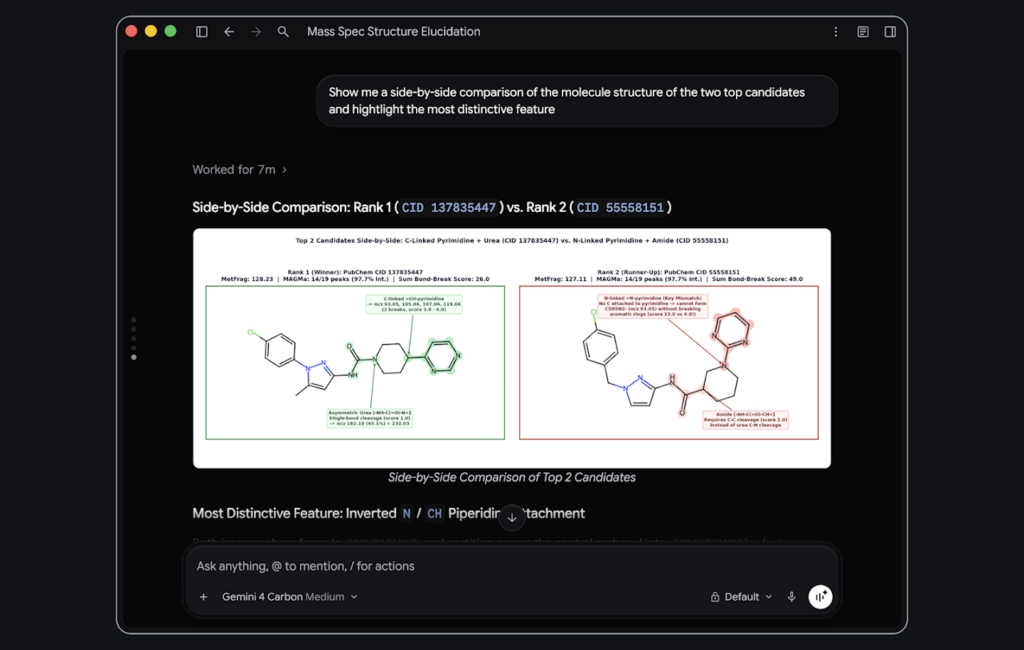
Several candidates explained the same 97.7% of fragment intensity, so the agent tested which were chemically consistent with the observed neutral losses. It ruled out isomers that lacked a central urea linkage and arrived at a single structure. It then checked the result with RDKit and drew the molecule with the main cleavage site highlighted.
Each stage can also be run separately, including noise removal, library searches, formula prediction, peak annotation and isomer comparison.
Benchmark results
DeepMind tested the system on 100 compounds from the Enamine REAL MS/MS collection in MoNA, running three attempts per spectrum. It compared three set-ups across the lightweight Gemini 3.8 Flash and the frontier models Gemini 4 Argon and Gemini 4 Carbon.
- No internet or skills: accuracy stayed below 4% for all three models.
- Internet access only: the frontier models missed a quarter to a third of spectra, and the lightweight model missed more than three-quarters, because self-written search scripts proved brittle.
- Internet plus Mass Spec Skills: all three models identified and verified the exact molecule in around 97% of attempts.
The skills also reduced token use per attempt, according to DeepMind: by nearly four times on Flash, by half on Argon and by nearly a fifth on Carbon.
Limits
DeepMind said some questions cannot be answered from an LC-MS/MS spectrum, such as mirror-image molecules and some closely related isomers, which need measurements like retention time, ion mobility or NMR. For genuinely new molecules absent from any database, the agent cannot confirm a structure alone. It can still supply a predicted formula, peak assignments and an annotation table as a starting point.
Dr Scott Jarmusch of the Technical University of Denmark said the approach shrinks work that took “days or months” to a matter of hours.
Availability
Users can download the Antigravity app and install the Mass Spec plugin. Enterprise users can choose “Use Business Account” and sign in with Google Cloud credentials. DeepMind is also offering 10,000 scientists the highest usage tier of Antigravity free for six months, onboarded on a rolling basis and subject to eligibility, capacity and selection. Applications are open.
Source: Google DeepMind