 Tech


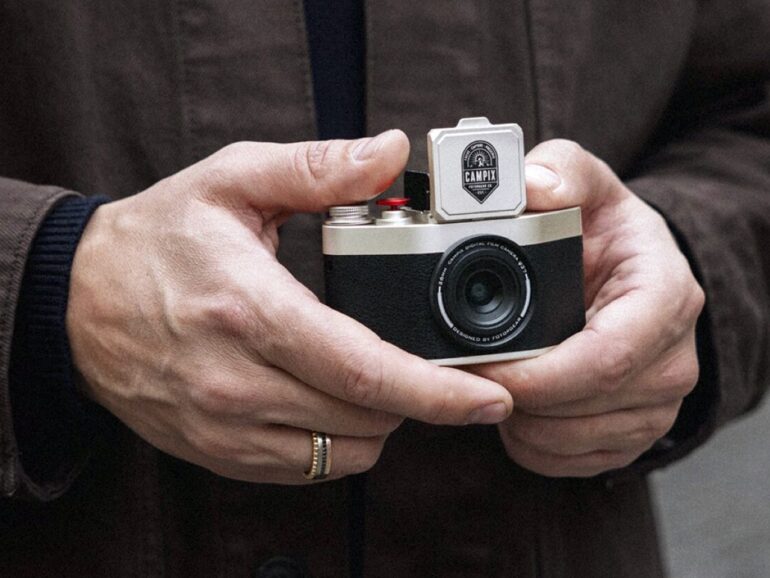
FotorGear, the Hong Kong company known for clip-on phone lenses, has launched its first standalone camera: the Campix, a 129g digital shooter with a waist-level viewfinder, no rear screen and a dial you turn between frames. It retails at $209, with Kickstarter pricing starting at $109, and shipping worldwide is due to begin in January 2027.
The design borrows from 1950s cameras, particularly the Exakta Varex, an East German SLR that allowed its prism to be swapped for a waist-level hood. Opening the lid on the Campix’s top plate reveals a small display recessed into a hood, which is the only screen on the camera. It shows battery level, the active film look and the number of frames left on the roll. There is no playback, so photos can only be viewed once they reach the companion app.
Shooting like it’s a roll of film
Each roll holds 36 digital frames. After pressing the red shutter button, the user has to turn a thumb dial before the camera will fire again. FotorGear labels it a rewind dial, though it works like a film winder. A second mechanical dial switches between six film recipe slots, and each roll commits the photographer to one look.
Recipes include EK80, a soft look modelled on 1980s colour stock, PT400 with creamy tones and diffused highlights, FunS, FJ100 and a monochrome option called SilBW. In the app, each can be adjusted for temperature, split toning, contrast, grain, halation, glow, vignette and chromatic aberration. Users can import their own LUTs and sync favourites to the dial. Every JPEG can be paired with a RAW DNG file.
Hardware
- Sensor: Sony IMX258, 13MP (4128 x 3096), 1/3.06-inch
- Lens: 26mm-equivalent f/2.2, four glass and two plastic elements, fixed focus from about 0.9m to infinity
- Exposure: fully automatic, ISO 100 to 3200, auto or manual white balance
- Flash: xenon tube with TTL metering, effective from roughly 1 to 3m
- Battery: 1000mAh, rated by FotorGear for about 400 shots with flash or 600 without
- Connectivity: Wi-Fi to the iOS and Android app, or USB-C; the included lanyard doubles as a USB-C cable
- Body: polycarbonate and metal, 97 x 35 x 58mm, with a 1/4-inch tripod thread
The app also offers double exposures with four blend modes, light leak and scratch effects and six shutter sounds. A desktop RAW Manager is available for macOS and Windows. The app is free with no subscription, according to the company.
Phone lenses fit the camera
The front of the Campix uses FotorGear’s T-mount, the same mount as its Retro series of phone lenses. The company said lenses already bought for a phone fit the camera directly. The range includes an 8mm fisheye, 16mm wide-angle, 60mm portrait, 75mm macro and 1.55x anamorphic. The stock lens also has a 37mm filter thread, and the top bundle includes star, circular polarizer and UV filters.
Pricing and bundles
The Campix Basic includes the camera, its 26mm lens and the USB-C strap, at $209 retail and from $109 on Kickstarter. For comparison, Fujifilm’s X half, which also offers a film-style mode, costs $849.
- Campix Set: adds a leather camera bag and the 60mm portrait lens, $199 on Kickstarter versus $319 retail
- Campix Full: the bag, 16mm, 60mm and 75mm lenses, plus star, CPL and UV filters, $359 on Kickstarter versus $509 retail
- 8mm fisheye: $79 add-on
Every unit carries a one-year warranty. The camera’s small phone-class sensor sets it apart from larger-sensor rivals such as the X half, but FotorGear is betting that the constraints, interchangeable lenses and low price will appeal to photographers who want a slower, more deliberate way of shooting.
Source: Yanko Design