 Tech


Snowflake has announced a set of tools at its Expedition 2026 event on 9 November that target one of the biggest blockers in enterprise AI: getting agents out of pilot projects and into production. The package covers shared business definitions, a central control layer for agents, and new automation features in its CoCo and CoWork assistants.
The company points to a survey it sponsored with MIT Technology Review Insights. Of 400 senior data and technology executives at firms with annual revenue of $500 million or more, 55% named a lack of business context as the main cause of poor-quality agent insights. Fragmented or inaccessible data came second at 45%.
Business Ontology: one definition of the numbers
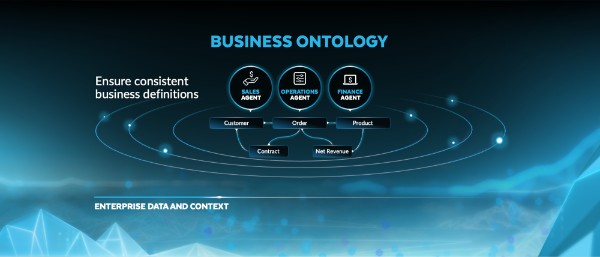
Business Ontology sits inside Horizon Context, part of Snowflake Horizon Catalog. Teams approve official definitions for concepts such as net revenue, assign an accountable owner and link each one to the underlying data, whether it lives in Snowflake or elsewhere. Agents, apps and people then work from the same definition.
A Semantic View calculates the metric, while Cortex Sense infers meaning where nothing has been defined. Approved definitions always take priority. Existing definitions can be migrated from a third-party catalogue or a spreadsheet in a single guided CoCo session, and every change is logged, so a question about what a metric meant in a past quarter becomes a lookup.
Cortex AI Gateway: one set of controls
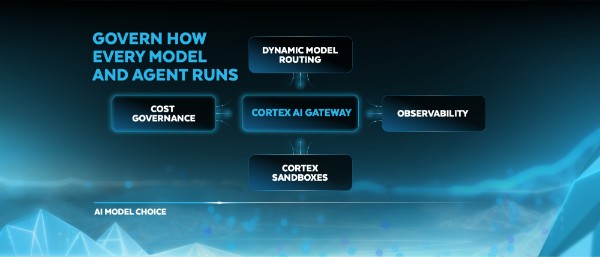
Cortex AI Gateway acts as a single entry point for agents, applying one set of policies across clouds, frameworks and AI providers. Calls made through MCP servers are checked against the company’s existing access policies, authentication and permissions, so agents inherit the controls already set for human users.
- Cost governance: attributes spend to the owning team and enforces hard limits.
- Observability: records each step in the customer’s own Snowflake account.
- Gateway Tools and AI Guardrails: check tool calls against fine-grained authorisation and defend against prompt injection and jailbreaks.
- Dynamic Model Routing: sends routine work to lighter, cheaper models.
- Agent Trace Intelligence and Agent Abuse Detection: analyse full agent trajectories to spot agents operating beyond their permissions.
CoCo, CoWork and the new Bots
CoCo is Snowflake’s coding agent for data teams and CoWork is its personal work agent for knowledge workers. CoCo Automations lets teams describe a workflow once and have it run at any frequency, such as a pipeline health check or a weekly report, with an audit trail and task history for each run. Both agents now reach into Slack, Excel and Google Sheets, and shared skills, plugins and profiles let one team’s setup be reused across the company.
CoCo and CoWork Bots go further. Given a high-level goal, such as preparing briefings for customer meetings, they plan and carry out the work in the background using the user’s own access rights and permissions, and come back only when a decision or approval is needed.
Christian Kleinerman, EVP of Product at Snowflake, framed the aim this way: “That’s the difference between an agent that guesses and an agent the business can run on.”
Pricing and availability
- Generally available: Cortex AI Gateway, cost governance, observability, CoCo Automations, and Skills and Plugin Sharing.
- Public preview: Cortex AI Gateway Tools, Cortex AI Guardrails, Snowflake for Slack, CoCo for Excel and Sheets, and Profiles in CoCo and CoWork.
- Public preview soon: Business Ontology.
- Private preview: Cortex Sense, Dynamic Model Routing, Agent Trace Intelligence, Agent Abuse Detection, and CoCo and CoWork Bots.
Regional adoption
Snowflake says NMC Healthcare, Emirates Insurance Company and InsuranceMarket.ae in the UAE, along with Zahid Group and Foodics in Saudi Arabia, are among the organisations using its data and AI capabilities. Ibrahim Çolak, Chief Data & AI Officer at InsuranceMarket.ae, said Snowflake gives the insurer a governed data foundation as it scales. The company puts its global customer base at more than 14,500 as of 2 September 2026.