

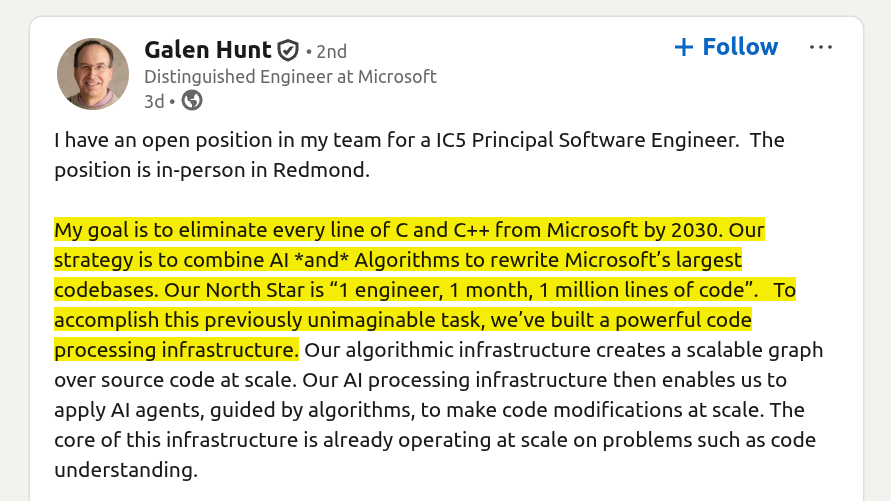
A Microsoft engineer named Galen Hunt recently caused a lot of discussion in the tech world when he talked about a plan to get rid of two very old computer languages. These languages, called C and C++, have been used to build almost everything in Windows and other Microsoft products for decades. Mr. Hunt shared on social media that his team had a goal to remove every line of this old code by the year 2030. This news was important because it suggested that Microsoft might be planning to rebuild its entire software system from scratch. However, the engineer later updated his statement to explain that this is actually a research project and not a new rule for the whole company.
Even though it is just a research project for now, the work is still very large in scale. The goal of the team is to find a way for a single engineer to update one million lines of code in just one month. Usually, a task like that would take dozens of people many years to finish. To reach this goal, the team is using artificial intelligence to do the heavy lifting. The AI acts like a translator that reads the old code and rewrites it into a newer language called Rust. This matters because it shows how companies are starting to use AI to fix old technology problems that were previously too big to handle.
Why the market is moving away from old code
The main reason Microsoft and other big companies like Google want to stop using C and C++ is because of safety. These older languages allow programmers to manage a computer’s memory directly, which is very fast but also very risky. If a programmer makes a small mistake, it can lead to a “memory leak” or a security hole that hackers can use to steal data. In fact, most of the serious security problems found in software today are caused by these kinds of memory mistakes. Because the old code is so complex, it is very difficult for humans to find every error, even if they are very experienced.
The newer language, Rust, was designed to solve these exact problems. It has built-in rules that prevent a programmer from making the most common types of memory mistakes. If you try to write code that is unsafe, the Rust software will stop you and tell you to fix it before the program can even start. Microsoft has already invested 10 million dollars to make Rust a top priority for its engineering teams. By switching to Rust, companies can build software that is much harder for hackers to break into. It is like replacing an old wooden door that can be easily kicked in with a modern security door that locks itself automatically.
How AI will play the role of the translator
Translating old code into a new language is a very difficult task because the two languages do not work the same way. It is not like translating a book from English to Spanish where the meaning stays mostly the same. In computer code, every single line has to be perfect, or the whole program will crash. Galen Hunt’s team has built a special system that creates a digital map of the old code. This map helps the AI understand how all the different parts of the software work together. Once the AI understands the “logic” of the old code, it can start writing the same instructions in the new Rust language.
This research is helpful for Microsoft’s customers as well. Many large businesses have their own old computer systems that they are afraid to touch because no one remembers exactly how they were built. If this project succeeds, Microsoft could offer these tools to other companies to help them clean up their “technical debt.” This is a term for the old, messy code that slows down a business and makes it vulnerable to attacks. By using AI to clean up this debt, companies can move their old systems onto modern, safe platforms without having to hire thousands of new programmers.
When does the transition begin?
Because this is currently a research project, there is no official date for when these tools will be finished or released to the public. Galen Hunt’s team is still in the process of building the infrastructure and testing it on Microsoft’s own internal systems. The goal of “eliminating every line” by 2030 is a target for the research team to aim for, rather than a promise to the customers. Microsoft has not mentioned any specific pricing for these tools yet, as they are currently being used to improve the company’s own software like Windows and the Azure cloud system.