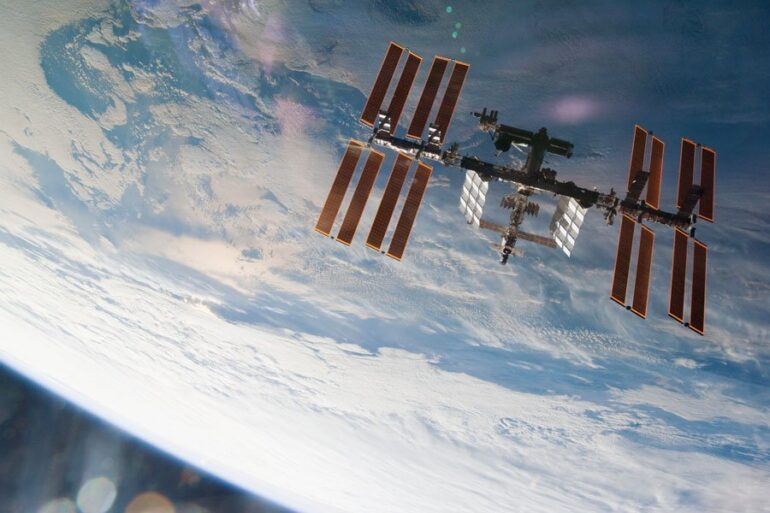

Google has presented a research initiative called Project Suncatcher that explores whether AI data centers can operate in space. The concept places compact satellites in a sun-synchronous low Earth orbit that maintains constant exposure to sunlight. This orbit allows each unit to collect solar energy more efficiently than Earth-bound facilities. The satellites would include machine learning hardware such as TPUs that operate directly from this sustained power source.
Table of Contents
Designed to test the limits of off-planet computation
The goal is to examine whether large-scale processing can become independent of terrestrial grids. Google’s researchers describe a constellation architecture in which satellites communicate with each other at bandwidths comparable to conventional hyperscale data centers. They propose multi-channel dense wavelength-division multiplexing combined with spatial multiplexing to reach transfer speeds in the tens of terabits per second. Achieving this level of capacity requires the satellites to fly within a few hundred meters of one another. A laboratory demonstration has already shown a link rate of 1.6 Tbps, although scaling this performance to orbit remains unproven.
Formation flying introduces complex engineering demands
Keeping satellites in close formation is one of the most demanding aspects of the project. The team uses Hill-Clohessy-Wiltshire equations and detailed numerical modeling to estimate the control efforts required to counter gravitational drift, atmospheric drag, and other orbital disturbances. Continuous station-keeping increases operational complexity and influences long-term costs.
TPU durability in radiation tests shows early promise
Google evaluated the resilience of its Trillium Cloud TPU v6e under proton exposure at 67 MeV. The tests revealed no critical degradation across doses that exceed expected levels for low Earth orbit. The most sensitive components, including high-bandwidth memory subsystems, showed only minor irregularities. These results indicate that existing TPU designs could operate in orbit with minimal modification. Verification in flight remains essential because bench tests cannot capture the full spectrum of orbital radiation effects.
Assessing whether the concept can be economically sustained
Project Suncatcher depends on future launch prices. Analysts within the project estimate that if launch costs fall below 200 dollars per kilogram by the mid-2030s, the expense of deploying and maintaining orbital compute modules could approach cost parity with ground facilities when measured in kilowatt-years. This projection assumes long mission lifetimes and very low servicing requirements. Neither assumption has been validated at scale. Any need for frequent satellite replacement or hardware retrieval would undermine the financial model.
Field testing begins with a two-satellite demonstration
Many parts of the proposal are still theoretical. Google has partnered with Planet to launch two prototype units in 2027. These satellites will test optical communication links and evaluate TPU stability in real orbital conditions. The outcomes will determine whether the architecture can transition from research to operational use. Key questions include energy consistency, communication stability across long distances, and the overall durability of hardware exposed to space for extended periods.