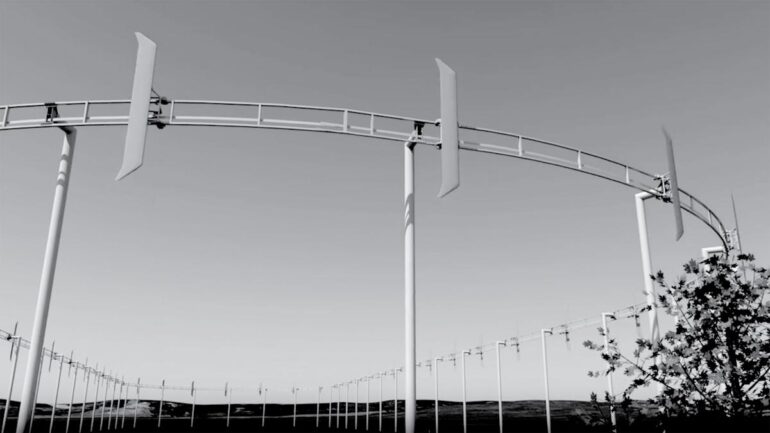

Airloom Energy is presenting its alternative wind power generation technology at CES 2026, positioning the system as a potential solution for powering data centers that are experiencing increased electricity demands driven by artificial intelligence workloads. The company has developed a wind turbine design that replaces the conventional tall tower structure with a track system measuring 20 to 30 meters in height. The design uses vertical wings that travel along an oval-shaped track, a configuration that company representatives have described as resembling a roller coaster mechanism. These wings adjust their orientation as they move around the curved sections of the track, angling themselves to capture wind energy along the straightaways where power is generated through linear motion transferred to ground-based generators
The declared technical specifications indicate that Airloom’s system requires 40 percent less mass than a horizontal axis wind turbine producing the same energy output. The design also incorporates 42 percent fewer total components and 96 percent fewer unique parts compared to standard turbines. For a 2.5 megawatt system, the company estimates production costs at approximately $225,000, compared to roughly $2.1 million for a conventional horizontal axis wind turbine of equivalent capacity. This represents a cost reduction of nearly 90 percent per unit. Airloom attributes these savings to the use of components that can be mass-produced and transported in standard shipping containers, eliminating the specialized logistics required for moving 80-meter turbine blades.
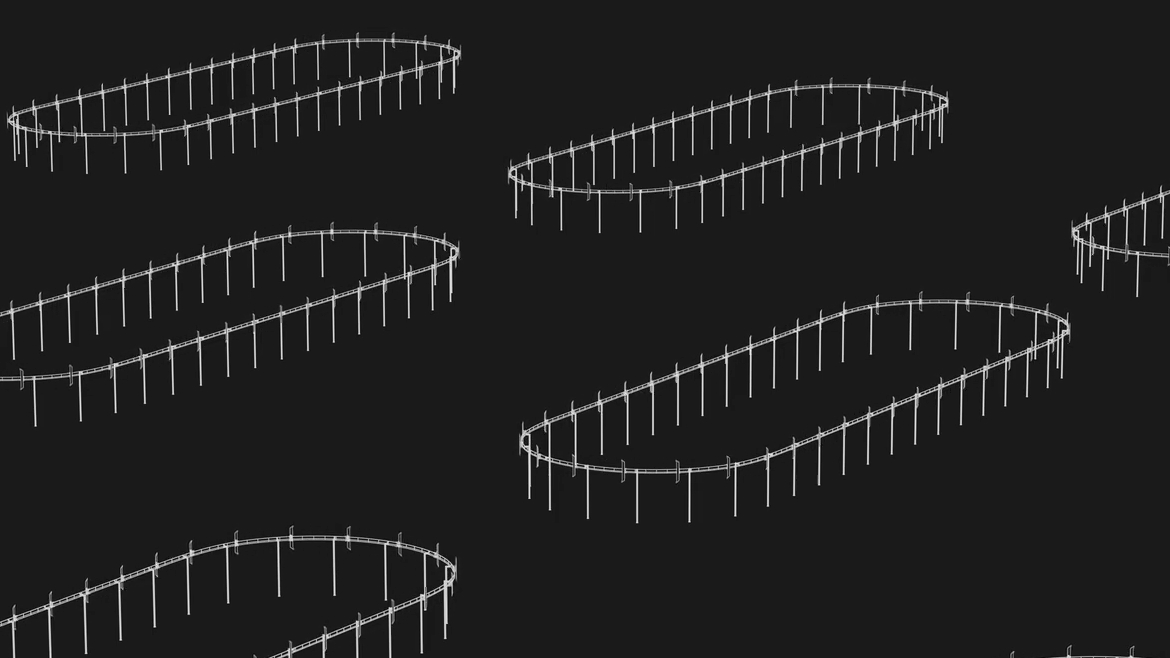
The dimensions of the system vary based on capacity requirements. The commercial-scale 2.5 megawatt version utilizes 10-meter vertical wings mounted on an oval track with straightaways extending approximately 500 meters, supported by poles positioned roughly 25 meters above ground level. Smaller configurations exist for testing purposes, including a 50-kilowatt model with 3-meter wings operating on a 45-meter by 22-meter track with 5-meter towers. The company has stated that the track length, wing size, and tower height can be adjusted to accommodate site-specific wind conditions and physical constraints, including uneven terrain and offshore locations.
Airloom broke ground on a pilot research and development site near Rock River, Wyoming in June 2025. The facility received $5 million in funding from the Wyoming Energy Authority to construct a demonstration unit intended to validate the system’s power curve, assess energy conversion efficiency, and refine deployment protocols ahead of commercial demonstrations scheduled to begin in 2027. The Wyoming project is supported by additional financing totaling $7.5 million from investors including Lowercarbon Capital, Breakthrough Energy Ventures, and several other venture capital firms, along with a $1.25 million contract from the United States Department of Defense.
The business case for Airloom’s technology extends beyond pure cost metrics to address grid capacity constraints. Data center electricity consumption in the United States is projected to reach 8 to 12 percent of total national demand by 2030, up from 3 to 4 percent currently. This surge has prompted utility companies to warn customers about potential rate increases to support infrastructure expansion. Airloom claims its systems can be deployed 85 percent faster than traditional wind turbines due to simplified assembly and transportation logistics, potentially accelerating renewable energy availability for power-intensive facilities. The company has received a CES 2026 Innovation Award in the Sustainability and Energy Transition category and will display technical documentation and engineering materials at its booth during the event, which runs from January 6 to 9 in Las Vegas.