
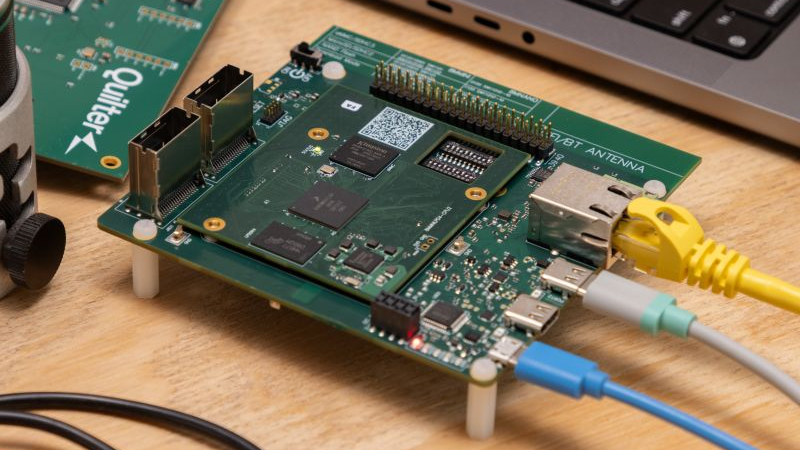
The startup Quilter recently completed a project titled Project Speedrun to show how artificial intelligence can change the way computers are built. Traditionally, designing a complex circuit board with hundreds of components can take a team of engineers several months of work. Quilter’s AI managed to complete the design phase for a dual-PCB Linux computer in only seven days. This machine is composed of 843 individual parts, which is a high level of complexity for a system designed so quickly.
What makes this achievement particularly notable is that the computer worked perfectly as soon as it was assembled. It successfully booted the Debian Linux operating system on its very first try. During the week of development, human engineers only spent about 38.5 hours on the project, mainly for supervision and final refinements. This shift allows engineers to move away from repetitive manual tasks and focus on the creative aspects of hardware design. By using AI to handle the placement of parts and the routing of electrical paths, the overall development cycle is shortened.
Optimization by utilizing physics
Quilter did not train its AI by simply having it copy existing human-designed circuit boards. Instead, the system was taught the physical laws that govern how electricity moves through hardware. This approach is different from many other AI models that learn by imitating human examples. By focusing on physics-based optimization, the AI can find unique ways to arrange components that a human designer might never consider. This method also avoids repeating common mistakes that can be found in older human-made designs.
This type of AI assisted design helps smaller teams create custom hardware that would otherwise require a massive budget and a large staff. Because the AI handles the iterative cleanup and execution phases, there are fewer chances for human error to be introduced during the process. While humans still oversee the project to ensure everything meets the necessary standards, the AI acts as a powerful tool that manages the most time-consuming parts of the engineering work. This could lead to a future where custom workstations and specialized computers are developed much more frequently.
Release and pricing information
The software used to design this computer is part of Quilter’s professional platform for hardware engineers. The company offers its AI design services through a subscription-based model. Interested firms can access the platform starting at $2,500 per month for small teams, which includes the ability to run multiple design iterations simultaneously. Larger enterprise packages are available with custom pricing based on the volume of projects and the complexity of the circuit boards being designed.
For those interested in the hardware itself, the Linux computer created during Project Speedrun was a demonstration of the technology rather than a retail product. However, Quilter plans to offer the design files as open source material for the engineering community to study. This allows other developers to see exactly how the AI arranged the 843 components and the dual-PCB layout. The goal is to encourage more companies to adopt AI-driven optimization in their own manufacturing processes throughout 2026.