
Verizon customers across the United States had a rough day on Wednesday. What started as scattered reports of connectivity issues around noon Eastern Time turned into a massive network outage that dragged on for over 10 hours before the company finally got things working again. If you were one of the people staring at an SOS symbol on your phone instead of the usual network bars, you were far from alone.
Table of Contents
When did the problems first start to appear?
Reports of Verizon network issues began pouring in around 12 PM Eastern Time. Customers quickly noticed something was wrong when their phones switched to SOS mode, which basically means your device can only make emergency calls. The problems hit both voice calls and wireless data, though text messages seemed to keep working for at least some users. Even Verizon’s own status page struggled to load because so many people were trying to check if the outage was real.
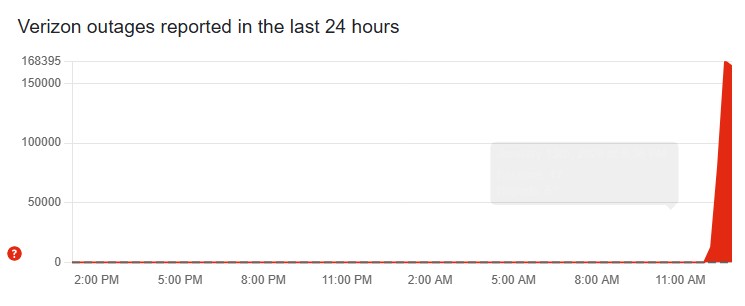
DownDetector, the website that tracks service outages, showed the scale of the problem. Reports climbed rapidly through the afternoon and peaked at over 181,000 people experiencing issues. That is a huge number, especially when you compare it to what was happening with other carriers. AT&T saw a small spike to around 1,700 reports, and T-Mobile had similar numbers. Those bumps were probably just people trying to call their friends on Verizon and thinking their own network was down.
Where were the people most affected?
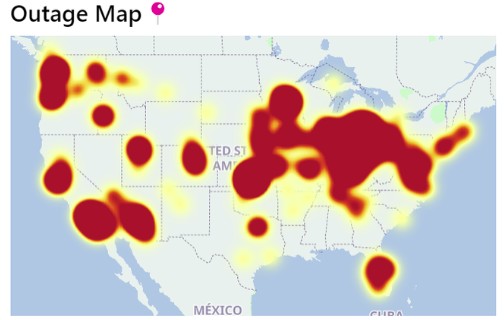
The outage hit hardest in major cities along the eastern United States. Boston, New York and Washington DC saw the biggest concentration of problems based on the heat maps showing where reports were coming from. But the issues spread as the day went on, with growing trouble spots appearing in Chicago, San Francisco and Los Angeles. Basically, if you lived in or near a major city and had Verizon, there was a good chance you spent at least part of Wednesday without proper cell service.
What did Verizon do in response?
Verizon acknowledged the problem fairly quickly on their news account on X, the platform formerly known as Twitter. The company said they were aware of issues affecting wireless voice and data for some customers and that their engineers were working to identify and fix the problem. That first statement came out not long after reports started spiking, which at least showed they were paying attention. But from there, updates became sparse.
The next meaningful update from Verizon did not come until over two hours later, when they said their engineering teams were fully deployed to work on the issue. Still no information about what was actually wrong or when things might be fixed. Then another long silence. By this point, thousands of customers were stuck without service and had no idea when it would come back.
The Fix that took nearly 10 hours to implement
As the afternoon turned into evening, the situation stayed frustrating. Some Verizon customers started reporting on social media that their service had come back, but then it would disappear again. Other people saw no improvement at all. The outage reports on DownDetector kept fluctuating but stayed in the tens of thousands well into the evening hours.
Verizon posted another update around 4:12 PM Eastern Time saying their team was on the ground actively working to fix the service issue. That was nearly four hours into the outage and still no real explanation of what had gone wrong. The company went quiet again after that, leaving customers in the dark for hours. By 6:20 PM, tens of thousands of users including some tech reporters were still without proper service, and Verizon had not said anything new in over two hours.
The outage has been resolved. If customers are still having an issue, we encourage them to restart their devices to reconnect to the network. For those affected, we will provide account credits. Details will be shared directly with customers. We sincerely apologize for the…
— Verizon News (@VerizonNews) January 15, 2026
The outage finally ended around 10:20 PM Eastern Time, more than 10 hours after it began. Verizon announced that the issue had been resolved and told customers who were still having problems to restart their devices to reconnect to the network. The company also promised account credits for people who were affected, though they did not specify how much those credits would be or when customers would receive them.
What is actually baffling is that even after the announcement, Verizon never actually explained what caused the outage in the first place. That is pretty similar to what happened during their last major outage back in 2024, which also lasted several hours and ended without a clear explanation of the root cause.
How the other carriers took advantage of this situation
T-Mobile and AT&T both took the opportunity to let everyone know their networks were working just fine. T-Mobile posted on X that their network was operating normally and as expected. AT&T went a bit further with their message, basically saying that if their customers were having trouble reaching people, it was not their problem, it was the other guys. Both companies were clearly trying to capitalize on Verizon’s bad day and maybe pick up some frustrated customers thinking about switching.