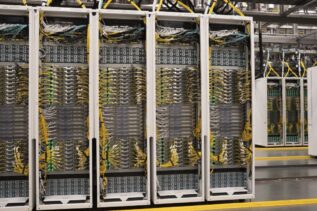
Microsoft’s AI superfactory is not a conventional data center. It is a distributed computing structure where connected facilities work as one machine to handle massive artificial intelligence training and inference tasks. The design confronts limits in networking speed, heat, power, and hardware utilization that arise when scaling AI. The choices in network design, cooling, and physical layout reveal how large AI workloads force a different approach to infrastructure.
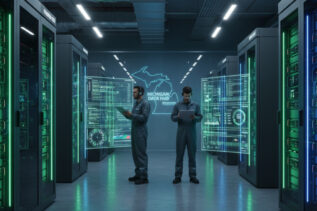
Hyperscale Data has announced a major expansion at its Michigan campus to host NVIDIA’s Blackwell architecture. The move marks one of the largest AI infrastructure buildouts in the Midwest, aimed at supporting high-demand GPU workloads for research, enterprise, and cloud operations.
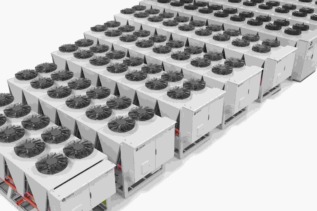
Vertiv has introduced high-capacity models of the Vertiv Liebert AFC inverter screw chiller range with low global warming potential (GWP) refrigerant for data centers across Europe, the Middle East, and Africa (EMEA). These new models provide up to 2.2 MW of cooling capacity in a single frame, reducing carbon emissions, installation time, and maintenance costs. The chillers support hybrid operation for AI and HPC liquid cooling applications, featuring up to 20% lower annual energy consumption and compliance with the EU F-Gas Regulation. Vertiv Liebert AFC chillers use eco-friendly refrigerant R1234ze HFO to enhance sustainability.
Hewlett Packard Enterprise (NYSE: HPE) today announced a new managed data center hosting service in the UAE in partnership with...