
An F1 car at 300 km/h crosses track limits in a fraction of a second. By the time a human steward recognises the violation, the car has already travelled roughly sixty meters. Across a race such as the Miami Grand Prix, twenty cars complete fifty-seven laps and pass through nineteen corners each time. That adds up to 21,660 potential track limit checks in ninety minutes. It is not realistic for humans to monitor all of this at full speed.
This is why, as of 2025, FIA stewards directly review only five percent of all limit cases. The remaining ninety five percent are handled by RaceWatch, the automated system developed by Australian sports technology company Catapult. The result is a reduction of more than one thousand work hours per year and a major shift in race operations. Fifteen years after the partnership began, RaceWatch has become a central part of the FIA’s decision making and safety framework.
Table of Contents
Instant detection that removes delays
The most recent milestone in the FIA and Catapult partnership is the integration of Track Limit Computer Vision into the RaceWatch platform. The system underwent refinement during testing in 2023, was introduced across FIA controlled series in 2024, and is now fully embedded in 2025 operations. It supports race control by detecting violations in under one second.
Catapult Chief Technology Officer Gareth Griffiths described the progress as the result of long term, purpose built development.
“We have spent fifteen years building systems that solve the challenges faced by race directors and stewards, and the TLCV is the latest example of how far motorsport specific technology can go.”
At circuits like Miami, where cars repeat hundreds of corner entries at high speed, the case for automation is clear. Machine learning allows RaceWatch to flag suspected violations quickly and consistently. That frees the stewards to concentrate on judgement rather than surveillance.
What RaceWatch actually is
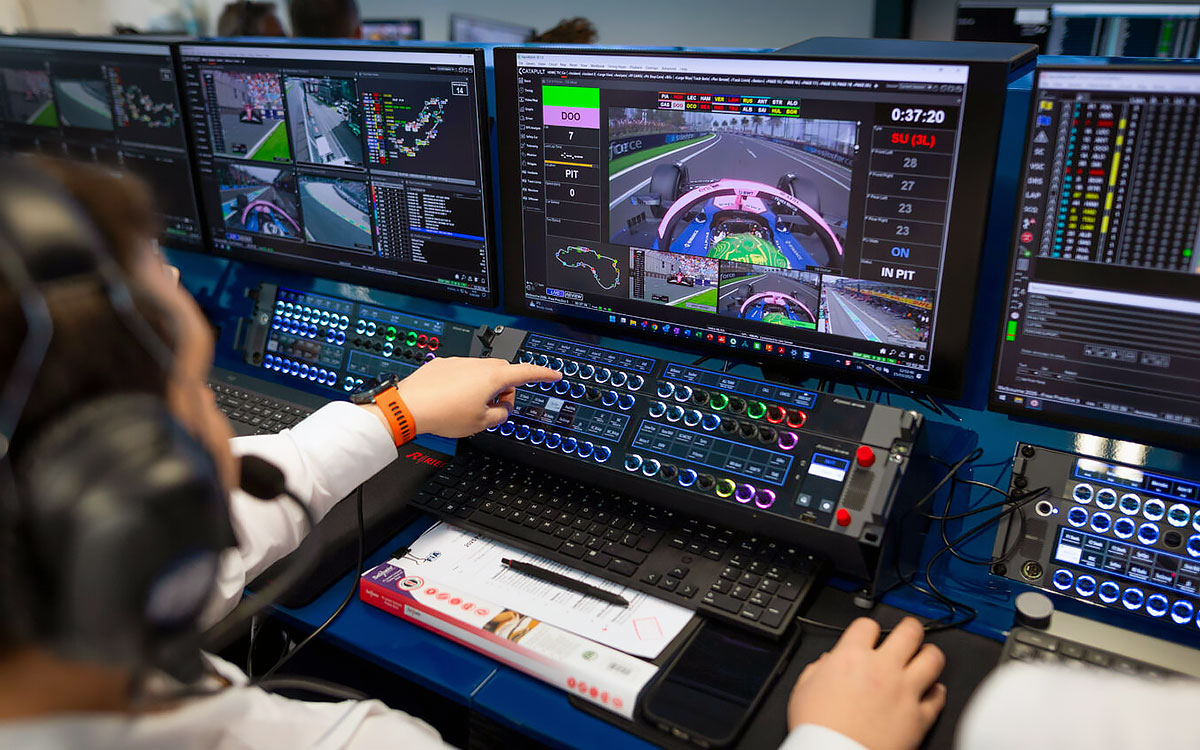
RaceWatch is not a single tool but the central ecosystem that supports race control, the Remote Operations Centre, the stewards and the pit wall. It combines detection, data processing, validation and communication in one environment. Its core functions include:
- Incident identification and penalty checks
- Monitoring of tyres and fuel flow
- Verification of grid alignment and pit stop procedures
- Live data support for strategy groups and broadcasters
Chris Bentley, head of information systems strategy for the FIA single seater division, explained its role clearly.
“The Catapult system is more than a tool. It is part of our daily operations, from the stewards room to the pit wall, helping us modernise adjudication, validation and communication.”
More than 120 high definition cameras and over 4,000 sensors on each car feed data into the RTAP and Focus servers. Timing, telemetry and positioning information are processed in real time. If an accident takes place, the system automatically retrieves the relevant camera angles and presents them to race control without delay. The ROC reviews the same data remotely and tags incidents when required. The stewards can then access relevant archives and comparisons through the Incident Hub to confirm the consistency of their decisions.
Every step, from data capture to review, sits inside one platform. RaceWatch handles the processing, while humans retain full authority over outcomes.
How the system has expanded across motorsport
Since 2009, the FIA and Catapult have supported more than one thousand races including Formula 1, the World Endurance Championship and Formula E. The system has grown from a safety support tool into the backbone of modern race operations. The technology used to support pit wall decision making is now being adapted for football, rugby and hockey, showing that the same logic applies across fast moving sports where officials need reliable and rapid information.
With the continued development of TLCV and RaceWatch, the FIA and Catapult are working toward even greater accuracy in judging and new efficiencies in race management. The next phase of development focuses on wider automation, clearer data presentation and stronger support for human stewards who remain responsible for the final call.