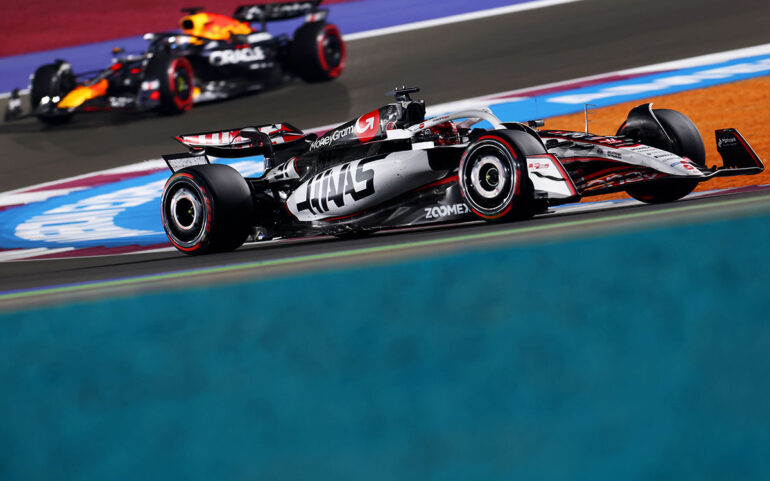

The Qatar Grand Prix enters its sprint day under a cloud of concern after Pirelli confirmed that tyre inspections revealed deep structural cracks across several sets. What began as a routine post-session evaluation has grown into a broader safety issue tied directly to Losail’s new gravel traps. The FIA and Pirelli are now preparing for the possibility of red flag interruptions or Safety Car deployments if track conditions deteriorate.
Pirelli’s chief engineer Simone Bella outlined the core issue. This year’s gravel additions at Turns 6, 10, and 16 were designed to enforce track limits, but the gravel differs from what drivers typically encounter. Instead of rounded stones, the sharp-edged material behaves more like a cutting surface. When drivers run wide or use the kerbs aggressively, gravel scatters across the racing line. Bella confirmed that several tyres developed cracks deep enough to reach structural layers, though none had yet cut fully through the carcass. He warned that running continuously over such debris significantly increases puncture risk.
The distribution of the damage is notable. Cracks appeared across all four tyres, showing no consistent pattern and suggesting that any car could be affected at any point in the lap. While the immediate danger is low enough for the sprint to proceed, both Pirelli and the FIA are treating the situation seriously. Bella said the FIA may intervene with red flags or a Safety Car if gravel buildup becomes excessive. Track crews are expected to conduct more frequent clearing runs to keep the racing line safe.
To reduce strain on the tyres, Pirelli has raised the minimum starting pressures by one psi, bringing the front slicks to twenty nine psi and the rears to twenty four point five. This follows the already imposed maximum limit of twenty five laps per tyre set, which was introduced to prevent structural overload in Losail’s high-energy layout. Teams now face an additional layer of risk management, as drivers must avoid kerbs that routinely drop fresh gravel onto the tarmac.
Losail’s tyre vulnerability has been a recurring theme since the circuit joined the calendar. Even before the new gravel was installed, previous events saw front-left punctures for several cars late in the race. The 2025 event opens with even greater uncertainty. Drivers will have to balance cornering aggression with tyre survival, a trade-off that could influence both qualifying traffic management and race strategy.
With Oscar Piastri on pole for the sprint, followed by George Russell and Lando Norris, the competitive picture remains tight at the front. Yet a race shaped by tyre fragility and surface hazards may reward caution over outright pace. Whether the sprint and main race unfold smoothly or become fragmented by interruptions now depends largely on how quickly the gravel issue can be controlled and how well teams adapt to the limits imposed on their tyres.