

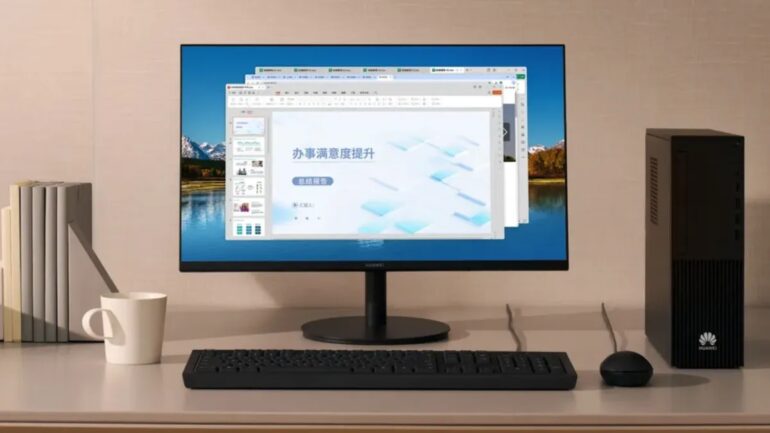

Huawei has presented two desktop PCs developed specifically for China’s business and government sectors. The Qingyun W515y and Qingyun W585y mark a continuation of the company’s strategy to promote homegrown hardware and software. They are equipped with Huawei’s Kirin 9000X processor and run Chinese Linux-based operating systems rather than Windows. This approach signals a clear intention to reduce reliance on external technology ecosystems.
Table of Contents
Hardware design remains familiar
The two workstations share identical dimensions of 11.5 by 3.7 by 12.4 inches and weigh 7.9 pounds without storage drives. Their chassis is unchanged from the previous W515x and W585x models. The front and rear panels retain a practical set of ports that includes USB Type-A connectors, a single USB Type-C port, HDMI and VGA outputs, audio jacks, and an Ethernet port. An optional DVD-RW drive is offered for legacy use cases, although most modern systems have moved beyond optical media.
Huawei includes a K100 wired keyboard and an M100 wired mouse with every unit. This reinforces the target audience of enterprise deployments where predictable configuration and standardised peripherals matter more than aesthetic upgrades.
Domestic operating systems replace Windows
Huawei has promoted HarmonyOS heavily across consumer devices, but these desktops run either UOS V20 or Galaxy Kylin V10. Both are Linux distributions built for enterprise environments that require a compliant alternative to Windows. Their inclusion aligns with China’s broader national objective to develop a software ecosystem that is independent of U.S. vendors.
Compatibility, application ecosystems, and support policies will play a large role in determining whether these systems can replace long-established Windows workflows in government and business environments.
Kirin 9000X becomes the central component
The Kirin 9000X is the primary hardware upgrade for these systems, although Huawei has not published detailed specifications. Reports indicate that it is an octa-core, sixteen-thread processor running at 2.5 GHz. It follows the Kirin 9000C used in earlier desktop workstations. The chip is based on Arm architecture, and its lineage can be traced to older designs produced by TSMC before export controls tightened. This creates uncertainty about how much of the current architecture is produced entirely within China.
An unclear leap toward technological independence
These devices hold symbolic and practical value for China’s long-term goal of reducing external dependency in critical technology. At the same time, many factors remain unknown. Huawei has not released benchmarks, pricing information, or software compatibility data. Without these details, it is difficult to assess whether the systems represent a substantial breakthrough or an incremental update designed to maintain momentum in China’s domestic computing push.
The global significance of these systems will depend on performance, enterprise adoption, and the strength of the supporting software ecosystem. Until those details emerge, their impact remains an open question.
