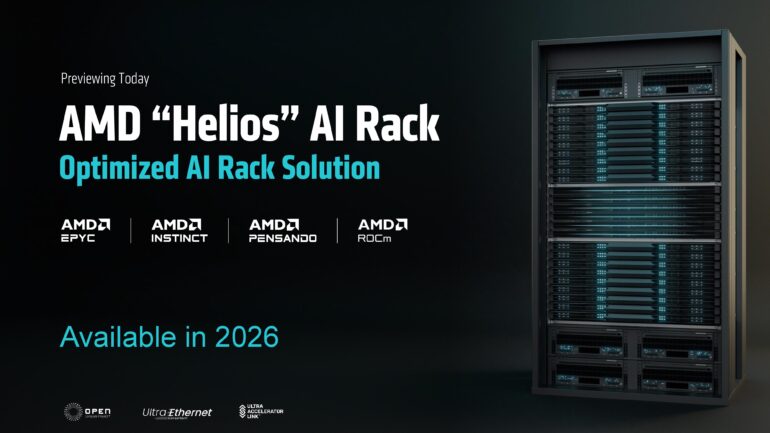

HPE has confirmed plans to integrate AMD’s Helios rack scale AI architecture into its systems beginning in 2026. The decision establishes HPE as the first major OEM partner for Helios and creates a clear commercial path for AMD’s next generation AI platform. The racks will incorporate 72 Instinct MI455X accelerators and will be paired with AMD’s EPYC Venice CPUs. This configuration is designed for high density AI workloads and will ship as complete rack scale systems.
The Helios architecture uses an Ethernet based scale up fabric developed by AMD and Broadcom. This structure connects GPUs and CPUs within a single pod, allowing workloads to operate across all accelerators without segmentation. The architecture follows Meta’s Open Rack Wide standard and relies on a double wide, liquid cooled chassis to house MI450 series GPUs, Venice CPUs and Pensando networking components. AMD has stated performance targets of up to 2.9 exaFLOPS of FP4 compute for the full configuration.
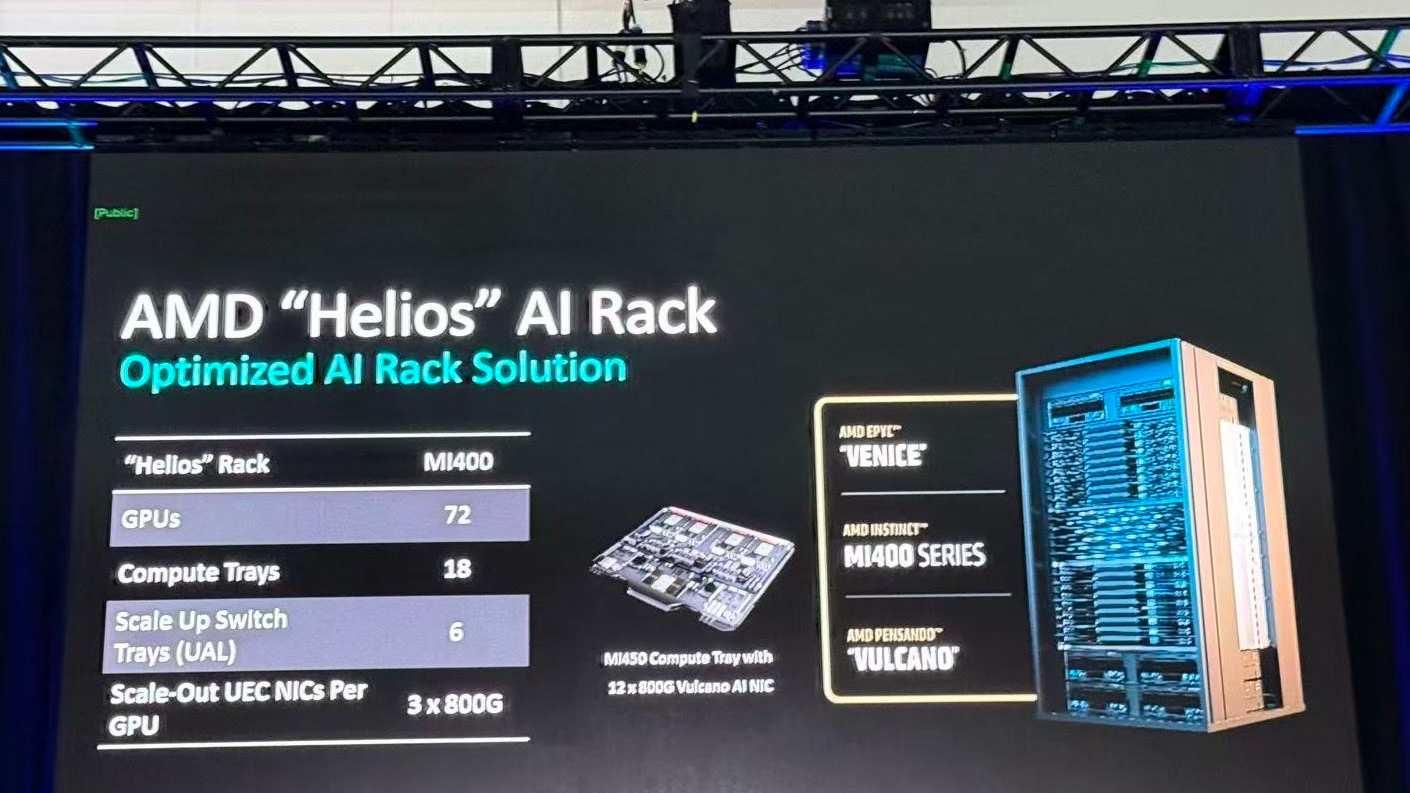
A key feature of the design is the use of Ultra Accelerator Link over Ethernet. This serves as the high bandwidth interconnect between GPUs and forms part of a wider alignment with Ultra Ethernet Consortium standards. The approach contrasts with Nvidia’s NVLink centric systems and gives Helios a different method for scaling hardware across racks. The interconnect design is intended to support large GPU counts, although real performance depends on variables such as cooling, traffic patterns and software implementations.
HPE’s involvement extends beyond Helios. The High Performance Computing Center Stuttgart has selected the HPE Cray GX5000 platform for its next supercomputer, named Herder. This system will use earlier generation MI430X GPUs and Venice CPUs in a direct liquid cooled blade configuration. Herder will replace the center’s current Hunter machine in 2027. HPE has indicated that waste heat generated by the system will be reused to warm campus buildings.
HPE and AMD expect global availability of Helios based systems next year. The adoption of an open Ethernet based fabric provides an alternative for organizations evaluating AI infrastructure outside of Nvidia’s rack scale ecosystem. While the design supports large scale workloads, sustained performance across multi node configurations remains unverified. Testing will determine how the single layer Ethernet approach behaves under intensive applications that demand high throughput and low latency.