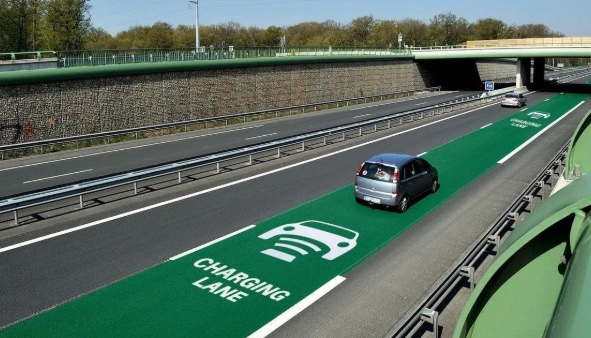

A short section of the A10 motorway outside Paris has become the clearest sign yet of how dynamic charging might change electric transport. As part of the Charge as you Drive programme, Electreon, Gustave Eiffel University, and Vinci have embedded induction coils beneath the road surface to assess how electric vehicles behave when charged while moving. The test area is 1.5 kilometres long and is the only open highway segment in the world currently operating such a system.
Vinci reported early results that show more than 300 kW of instantaneous power and an average of 200 kW during stable conditions. The trial vehicles, which include a truck, a van, a passenger car, and a coach, all use custom receivers mounted beneath the chassis. These receivers collect power from the embedded coils without physical contact.
Table of Contents
Battery weight could fall sharply
If deployed at scale, Vinci argues that dynamic charging would allow vehicle batteries to become smaller because they would no longer be required to hold the entire range needed for long journeys. Heavy duty trucks in particular could shed multiple tonnes of battery mass. In theory this would reduce the cost and carbon footprint of each vehicle and simplify logistics planning by removing dedicated charging stops.
The company emphasised that range limitations and long charging sessions are two of the most expensive constraints for fleet operators. A predictable supply of energy from highways could correct both issues at once. From a national perspective, France sees clear potential to shrink emissions from freight operators, who account for a significant share of the country’s greenhouse gas output.
Dynamic charging is spreading, but costs remain stubborn
The French project is the first to be tested on public highways, although similar closed route trials exist in Sweden, Germany, and parts of the United States. Wireless charging itself is not new, but the technology has only recently matured to the point where it can operate reliably under real road conditions.
Porsche has already shown that static wireless charging can be offered commercially, with an 11 kW home pad available for the forthcoming Cayenne EV. Dynamic charging requires substantially more hardware, however, and the cost of retrofitting receivers to existing vehicles has not been detailed. Nor has Vinci given clear figures on infrastructure installation costs, which are widely expected to be substantial.
Replacing long stretches of highway or tearing up existing lanes would produce major disruption. The initial construction expense would also compete with established alternatives such as overhead cabling for buses or electric trams, which many cities already use to decarbonise transport without full roadway reconstruction.
A promising idea with heavy requirements
Vinci’s long term goal is to encourage freight companies to shift to electric drivetrains. For that to succeed, governments would need to take on the considerable financial burden of upgrading infrastructure. Dynamic charging may be technically sound, but its viability depends on whether transport ministries are willing to invest.
While the A10 trial proves the concept works at scale, the real test will be political and economic rather than technological. The system can help reduce emissions and lighten vehicle batteries, but the challenge now lies in convincing policymakers that the benefits justify the cost.