


Astronomers have reported a discovery that aligns with long-standing objectives in exoplanet research. The goal is to directly capture images of Earth-sized planets orbiting at distances from their stars where liquid water could exist. Detecting these worlds in visible light remains beyond routine capability. However, the new finding identifies a star system that meets stringent criteria needed to evaluate the performance of advanced coronagraph technology aimed at that objective.
Current exoplanet detection methods have been successful in identifying thousands of planets beyond our solar system. Most of these detections rely on indirect approaches such as the transit method, where a planet passing in front of its star causes a measurable dimming. Other methods include measuring the gravitational tug a planet exerts on its host star or using variations in star motion. Indirect detections provide vital information about planet sizes, masses, and orbital periods but do not yield direct images.
Direct imaging of exoplanets is technologically demanding because the light from stars outshines the faint reflected light of orbiting planets by factors of millions to billions in visible wavelengths. Coronagraphs are instruments designed to block starlight so that light from orbiting companions can be isolated. Advances in coronagraph design, coupled with adaptive optics and space-based telescopes, have enabled imaging of some gas giant planets and brown dwarfs around nearby stars. These objects are large, emit much of their own heat, and orbit at wide separations.
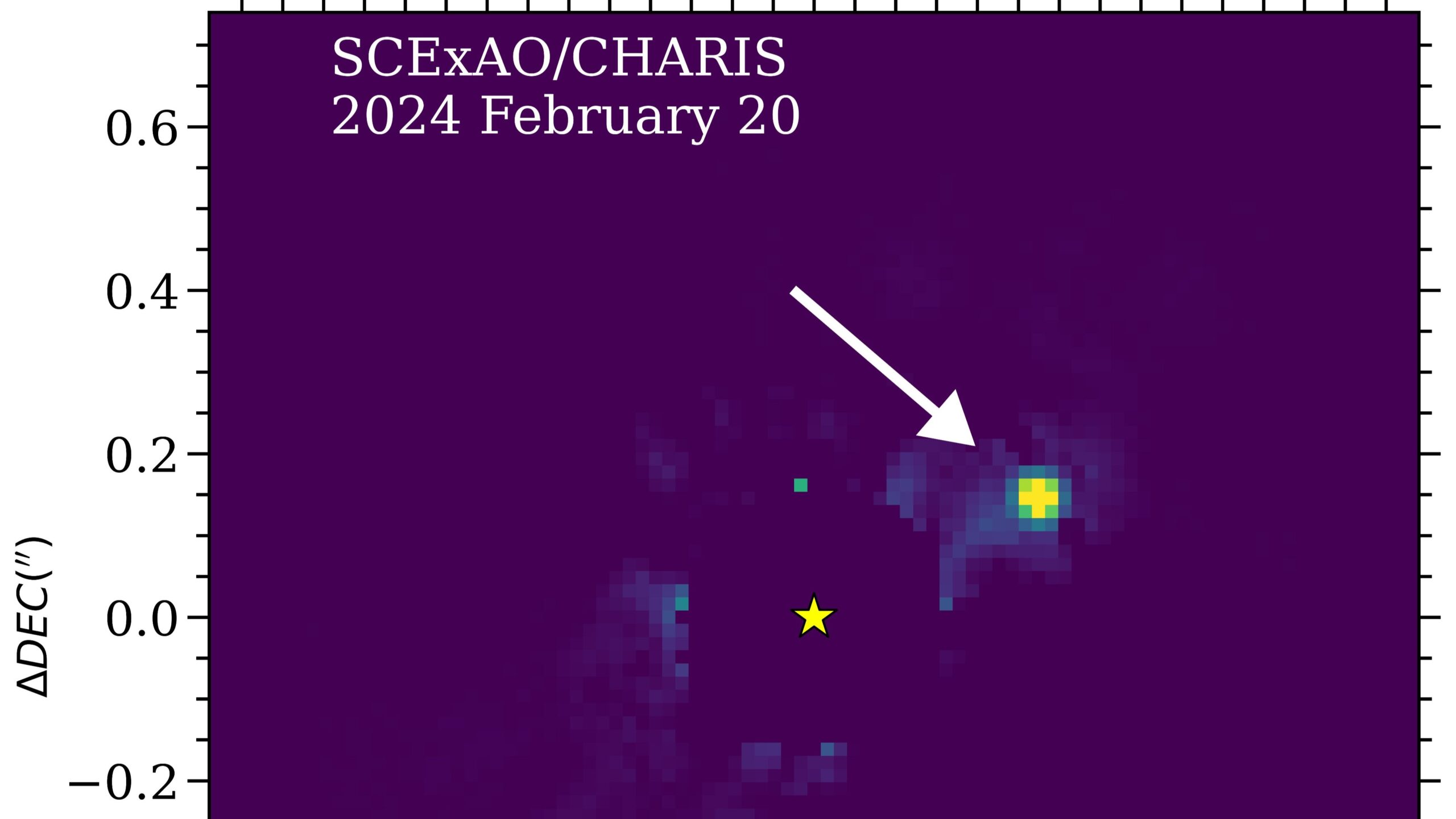
The new discovery, described in recent scientific commentary, identifies a stellar configuration with the right balance of factors that allow current coronagraphs to be tested in a regime closer to what would be needed to image Earth-sized worlds at Earth-like distances. The specific system, referred to as HIP 71618 B, is a companion star with attributes that create an environment where the contrast between the star and a potential orbiting planet could be evaluated with existing or near future instruments. The significance of this lies in understanding how well coronagraph designs perform when the brightness ratio and angular separation fall within the required thresholds.
Current flagship telescopes like the James Webb Space Telescope and the Hubble Space Telescope have made strides in direct imaging of large exoplanets. Webb’s instruments use coronagraphs to block starlight and have captured images of massive planets at wide orbital distances. These observations help refine models of planet formation and atmospheric properties. Direct imaging of smaller, rocky planets remains a frontier because of the enormous contrast challenge posed by starlight in visible wavelengths.
The field of exoplanet research includes plans for future space missions dedicated to imaging Earth-like planets. Proposed observatories such as NASA’s Habitable Worlds Observatory aim to combine large aperture telescopes with advanced coronagraphs and wavefront control systems. These missions would target nearby Sun-like stars with the explicit goal of detecting Earth-sized planets in their habitable zones. The recent identification of a system like HIP 71618 B provides an empirical test case for evaluating instrument performance ahead of those missions.
Instrument contrast refers to the ability of a coronagraph to suppress starlight while allowing the faint light from a planet to be detected. Achieving contrast ratios of a hundred million to one or greater is necessary for imaging planets like Earth around Sun-like stars in visible light. Factors that influence contrast include optical quality, stability of the telescope platform, and the algorithmic suppression of diffracted starlight. Stellar systems with favorable brightness ratios and separations allow instrument performance to be benchmarked under realistic conditions.
The new discovery does not mean that an Earth-like planet has been directly imaged. Rather it provides a physical environment where next generation systems can be tested and calibrated. This testing is fundamental to advancing designs that will be deployed on future telescopes. The ability to suppress starlight and reveal the faint signatures of orbiting planets is central to the scientific aim of studying planetary atmospheres and searching for potential biosignatures.
Observations of exoplanets in reflected visible light would yield complementary information to existing data collected in infrared wavelengths. Visible light captures reflected starlight from a planet’s surface and atmosphere, offering distinct insights into composition, cloud cover, and surface features. Infrared observations provide thermal emission data that help characterize temperature and atmospheric structure. Together, these approaches form a more complete picture of distant worlds.
Efforts to detect Earth-analog planets continue in full steam on multiple fronts. Radial velocity surveys and transit missions like those conducted by space telescopes such as Kepler and TESS have catalogued thousands of candidate planets. Some of these fall within habitable zones where conditions might permit liquid water. Targets like these are of particular interest for follow-up observations by advanced imaging systems.
