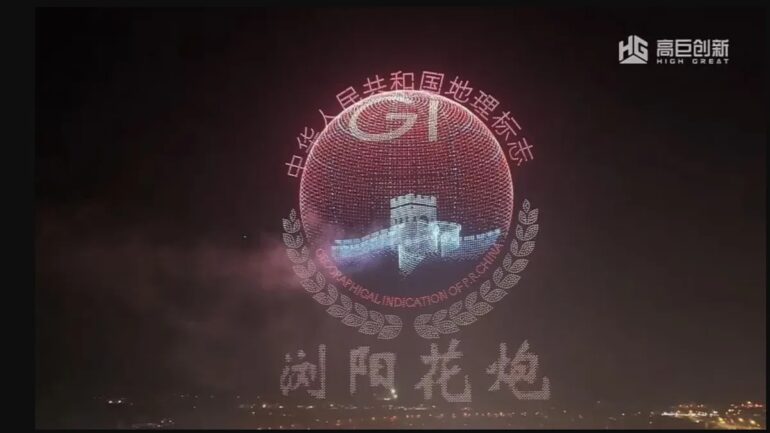

Liuyang has built its reputation on pyrotechnics, but its most recent achievement replaced fireworks with thousands of precision-controlled drones. The city hosted a synchronized display involving 15,947 aircraft, now recognised as the largest coordinated drone performance ever recorded. The show formed towers, floral patterns, and a vivid representation of a “Sky Tree,” all guided through software rather than combustion. This was an event where engineering defined the spectacle.
The operation achieved two Guinness World Records. The first was for the number of drones controlled from a single computer. The second was for the 7,496 drones that launched fireworks effects during the flight sequence. The project was organised by Gaoju Innovation with technical support from local specialists accustomed to managing large-scale firework events. The shift from gunpowder to code reflects a broader trend in entertainment technology, where traditional displays are increasingly replaced or supplemented by programmable light formations.
Each drone followed its assigned path through RTK-based positioning and mesh networking. Real-time corrections allowed thousands of units to maintain formation with minimal drift. The underlying systems resemble those used in autonomous navigation, high-accuracy surveying, and industrial fleet management. The difference here is scale. Making thousands of units behave as a single coordinated structure places considerable pressure on both software reliability and communication integrity.
Large drone performances are not risk-free. Liuyang has previously experienced an event where malfunctioning aircraft caught fire and fell towards spectators. Those incidents underline how sensitive mass-flight operations are to software faults, hardware inconsistencies, and unexpected environmental changes. Thousands of lithium-powered devices sharing airspace create a narrow safety margin, regardless of the technology’s sophistication.
This display stands out not only for its choreography but also for what it implies. The same systems capable of coordinating light displays can support non-entertainment tasks such as mapping, communication support, or electronic interference. The overlap between civilian drone art and defence-oriented research is clear. Any technology that can guide thousands of units with centimetre-level accuracy will attract interest far beyond event organisers.
The record also signals rising international competition in the drone-show industry. China’s demonstration is likely to encourage other countries and companies to test their own capabilities. For now, the Liuyang display remains a benchmark for large-scale autonomous coordination and a reminder of how software-driven control can transform hardware into a tightly orchestrated visual system.