
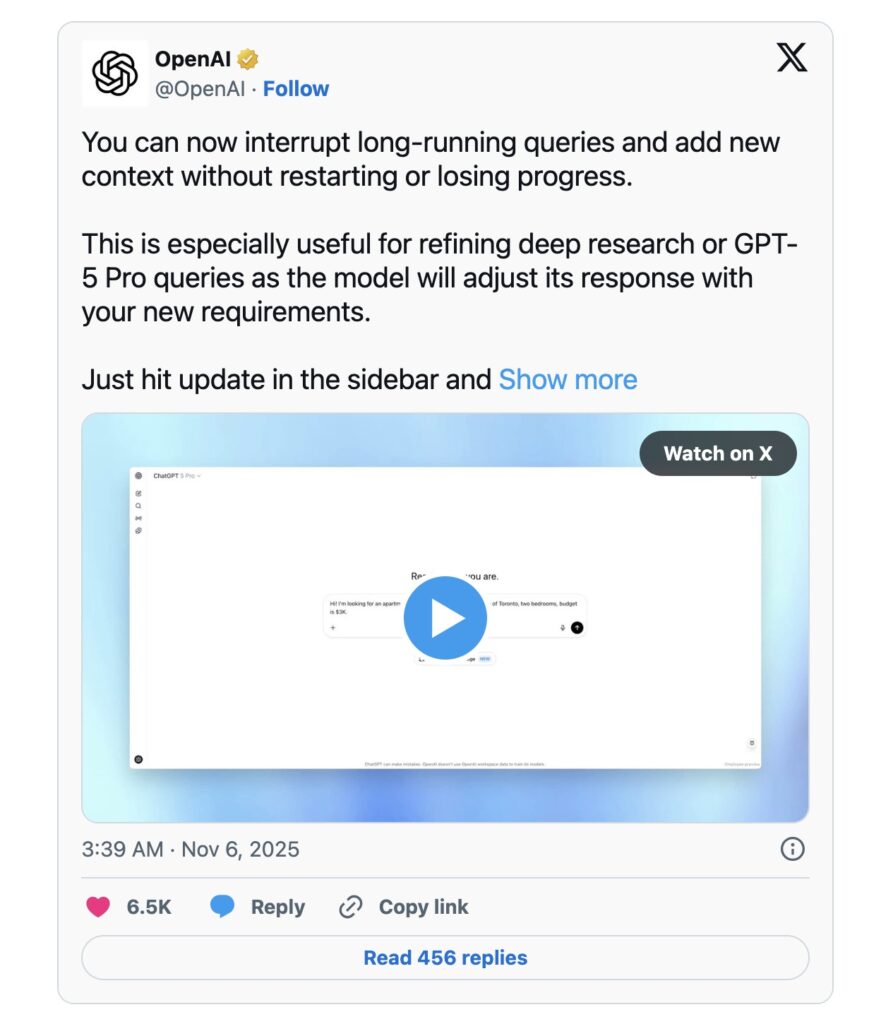
People often notice a missing detail in a prompt only after sending it, and that mistake becomes more frustrating when the model is using GPT 5 Pro or running Deep Research. These modes take longer to reply and may have daily limits, which makes a restart a costly step. OpenAI has now introduced the ability to interrupt ChatGPT while it is generating an answer. During the response, users can press Update in the sidebar, add new context, and change the direction of the reply on the spot.
The model immediately adjusts its reasoning, which removes the need to scrap the entire chain of thought. This change is especially helpful for analysts, researchers, and writers who rely on long, multi step prompts and cannot afford to repeat long runs of text just because one source or instruction changed halfway through.
Table of Contents
Faster corrections for long and complex tasks
The impact becomes clear when dealing with detailed work. Someone preparing a technical report can now correct a mistaken data source by updating the prompt instead of waiting for the model to finish an inaccurate explanation. The reply adapts in real time, which avoids the cycle of stopping, reframing, and regenerating long outputs. It also reduces the familiar frustration of seeing the model confidently follow the wrong assumption for several pages.
This feature pushes ChatGPT closer to a real collaborative tool instead of a strict turn based system. It listens as it writes, which means the user no longer has to wait for their turn to speak. The feedback loop becomes smoother and more natural for tasks that require active refinement.
 Screenshot
A shift in how ChatGPT handles user feedback
Models in the past tended to push forward even when they misunderstood the request. Follow up prompts helped, but the corrections always came after the model finished its response. The new approach gives users more control during the process and prevents wasted time. It does not make the system self aware, but it does make it more responsive to ongoing guidance.
The shift signals how OpenAI wants the interface to evolve. Instead of a static chat model that produces answers in isolation, ChatGPT is moving toward an adaptive workflow tool that can adjust its reasoning while it is still forming the answer. For people who rely on the model for complex research or time sensitive work, the improvement is likely to become part of their daily routine.