
Blue Origin has announced TeraWave, a new space-based connectivity network that Jeff Bezos’ rocket company says will deliver global high-speed internet to enterprise, data centre, and government customers. The Blue Origin TeraWave satellite internet project is not chasing the mass consumer market that Starlink has built, at least not initially. Instead, it is going after a much smaller and significantly more demanding customer base, and pitching a spec sheet that is hard to ignore.
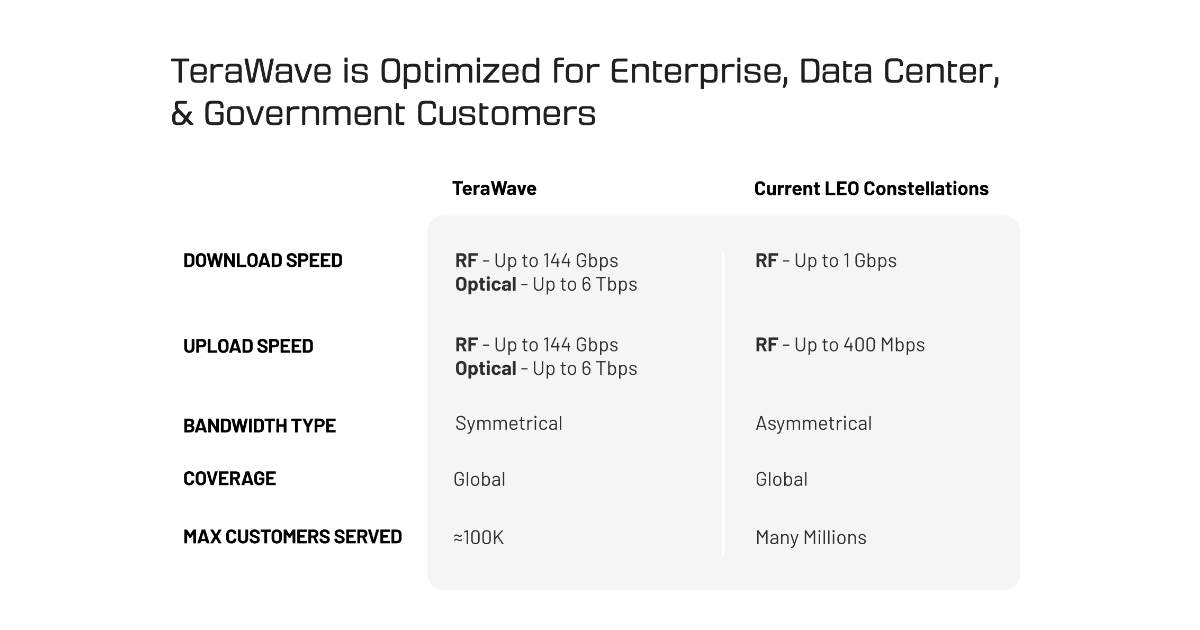
The headline numbers are striking. TeraWave is promising up to 6Tbps capacity through optical inter-satellite links and up to 144Gbps per individual customer via radio frequency. Symmetrical upload and download speeds are also part of the package, which is a meaningful differentiator from most existing low-earth orbit networks that still skew heavily toward download performance.
How TeraWave is actually built
The constellation behind TeraWave will consist of 5,408 satellites in total. Of those, 5,280 will sit in low-earth orbit handling radio frequency access, while 128 will be placed in medium-earth orbit specifically to support the optical, light-based links that enable the high-capacity backbone performance. Blue Origin describes it as a complement to fibre backhaul rather than a replacement, combining high-performance radio frequency connectivity with optical capability in a single architecture.
That is a more measured framing than some of the wilder satellite internet promises that have come and gone over the years. Blue Origin TeraWave satellite internet is not trying to replace terrestrial infrastructure. It is positioning itself as an enterprise-grade overlay that fills gaps fibre cannot easily reach, or provides redundancy where fibre can.
By contrast, existing LEO networks for mass consumers currently offer around 1Gbps download and 400Mbps upload on average via radio frequency. The TeraWave architecture is designed for far fewer, far more demanding customers, with the company citing a target base of around 100,000 users versus the many millions served by networks like Starlink.
Where it fits in the broader space internet race
Starlink is the obvious benchmark here, with more than 9,000 satellites now in orbit and a consumer subscriber base that has spent years lapping up broadband in areas traditional ISPs never bothered serving. SpaceX has turned LEO satellite internet from a concept into a working business at scale, and any new entrant into this space is going to be measured against that.
Amazon’s own Leo network, formerly Project Kuiper, is also in the picture. It currently has 180 satellites in orbit with plans for over 3,200.
Separately, Amazon will continue using Blue Origin as a launch partner to expand that constellation, taking advantage of the New Glenn rocket that Blue Origin has been developing. So there is a layer of commercial cooperation sitting alongside what is otherwise a competitive landscape involving companies closely tied to Jeff Bezos.
The 2027 timeline is the question mark
TeraWave is expected to begin its rollout in the final months of 2027. That is years behind where Starlink already is, and it means Blue Origin is entering a market that will look quite different from the one it surveyed when this plan was conceived. By 2027, Amazon Leo should be significantly further along, SpaceX may have added more satellites again, and customer expectations will have continued shifting upward.
Whether the Blue Origin TeraWave satellite internet proposition is compelling enough to carve out real market share among enterprise and government buyers depends on whether the optical link performance lives up to the specification on paper and whether the company can actually execute to that timeline. Blue Origin has had a complicated history with timelines, and enterprise customers in particular have long memories.
The technology direction is solid. High-capacity optical connectivity between satellites is genuinely where the more serious enterprise satellite proposals are headed, and pairing that with a reliable RF access layer is the right architecture for the use case. Getting there before the window narrows further is the challenge.