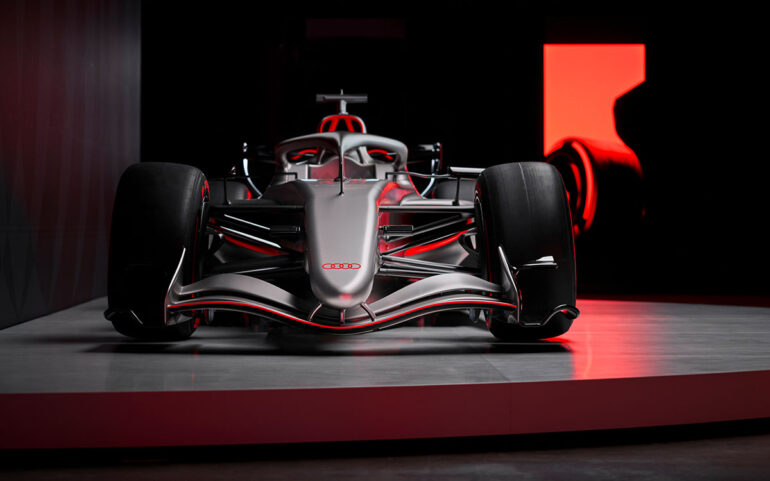

As Audi approaches its first Formula 1 appearance in 87 years, activity inside its Neuburg facility has intensified. The manufacturer will enter F1 in 2026 after taking over the Sauber team, and has opted for a full works programme, producing both the chassis and the power unit in-house.
The scale of the challenge is significant. Audi enters the championship years behind established rivals, and its leadership has acknowledged the size of the development gap. In response, the company has adopted an aggressive strategy built around producing large quantities of engines during the first development cycle.
Table of Contents
Producing 50 to 100 engines despite a three-engine race limit
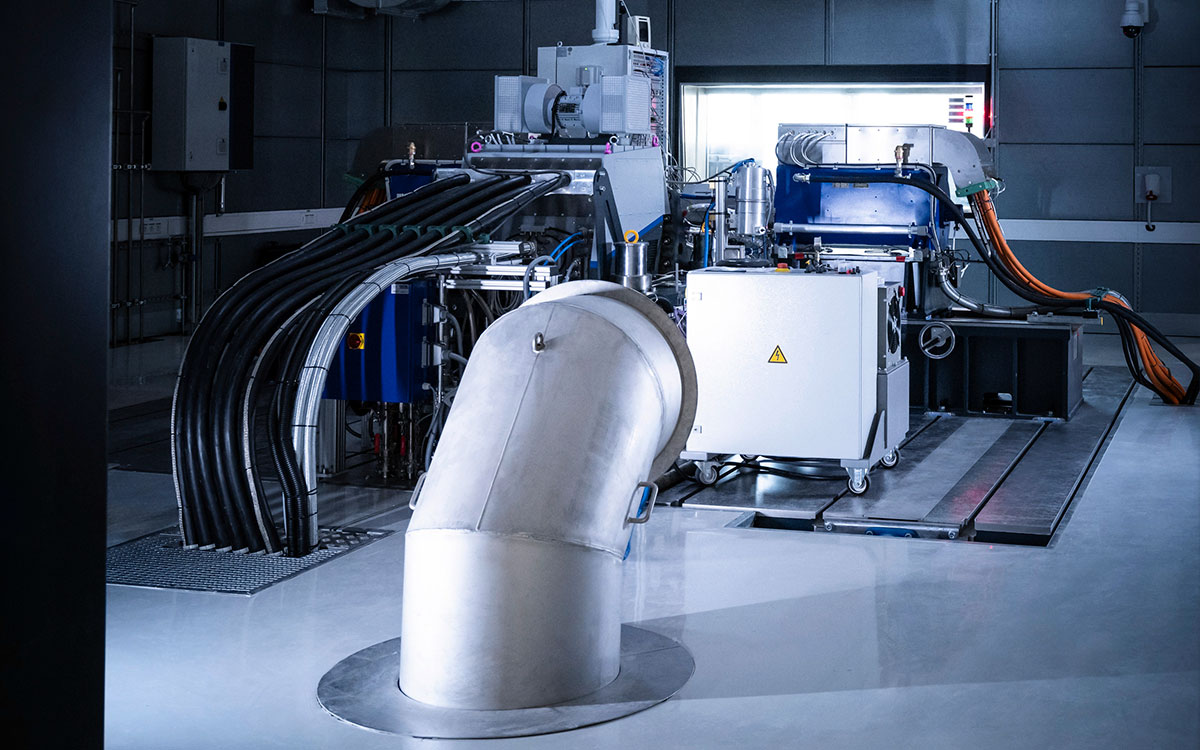
Formula 1’s 2026 sporting regulations allow each driver to use only three internal combustion engines per season. Yet according to reporting from Autocar, Audi intends to manufacture 50 to 100 power units during its first year.
Only the highest-performing units will be selected for race use. The remainder will support durability testing, performance validation, and development work on both the combustion engine and hybrid components.
Why produce so many? Audi COO Christian Feuer explains the context:
“We are six years behind.”
That gap reflects the advantage held by long-standing engine manufacturers such as Mercedes, Honda, Ferrari, Red Bull Powertrains, and Ford. Audi’s hybrid system is more advanced, but the V6 turbo is still in its early test phase, and performance projections remain uncertain.
Producing engines in large quantities allows Audi to gather data rapidly and refine its design despite 700 hours of permitted dyno testing per year. The introduction of carbon-neutral fuels for 2026 adds another layer of complexity, requiring extensive development work to optimise combustion characteristics.
Binotto leads engineering as Audi steps into unknown regulations
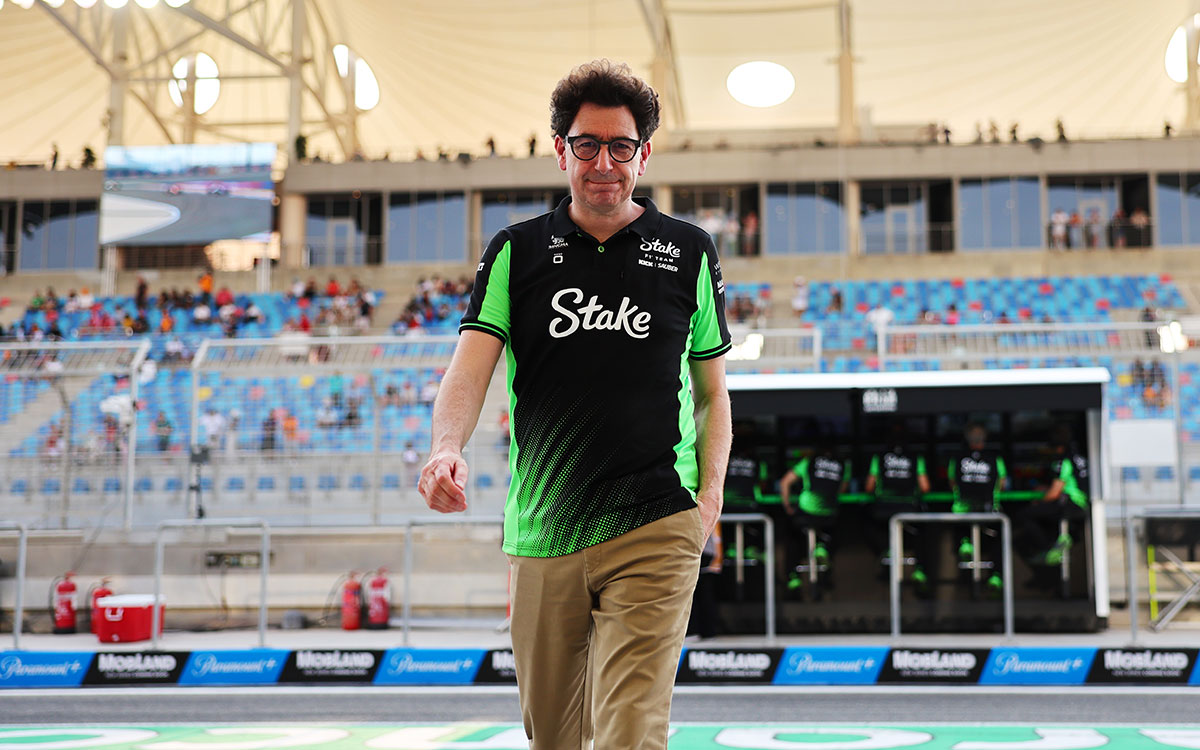
The technical project is led by Mattia Binotto, former Ferrari team principal, now serving as Audi’s F1 project director. He has been direct about the size of the task.
“We are fully aware of how difficult a challenge this is, with the goal of fighting for the championship in 2030.”
He emphasises that controlling both the chassis and the powertrain internally is essential if Audi intends to reach the front of the grid.
“Audi is in F1 not to participate, but to win, so we had no choice but to accept this complexity.”
Audi CEO Gernot Dörner echoed the sentiment:
“When Audi enters a race, it’s not just to compete, it’s to win. If we’re going to do it, we’re going to do it thoroughly. If we can’t do it, we don’t do it in the first place.”
2026 rules reset levels the field, but raises uncertainty
The 2026 regulations introduce sweeping changes, including:
- Active aerodynamics
- Revised hybrid power architecture
- New combustion layouts
- Reduced drag concepts
- Sustainable fuels
The result is a competitive landscape where no team knows where it will stand.
“What was once important may be replaced by something else today or tomorrow,” Audi notes internally. “For decades we have optimised our tools to fit stable regulations. Now everything is changing.”
In this environment, Audi hopes that its intensive power unit programme and willingness to embrace complexity will reduce the performance deficit caused by its late start.
Whether the “Four Rings” enter 2026 as midfield runners or early disruptors remains unknown. What is clear is that Audi has committed fully to its long-term objective.